Venezuela to turn over 30 to 50 million barrels of oil to US
WASHINGTON / CARACAS – January 7, 2026
U.S. President Donald Trump has announced that “interim authorities in Venezuela” have agreed to hand over between 30 million and 50 million barrels of sanctioned oil to the United States.
In a statement posted on his social media handles, Trump declared:
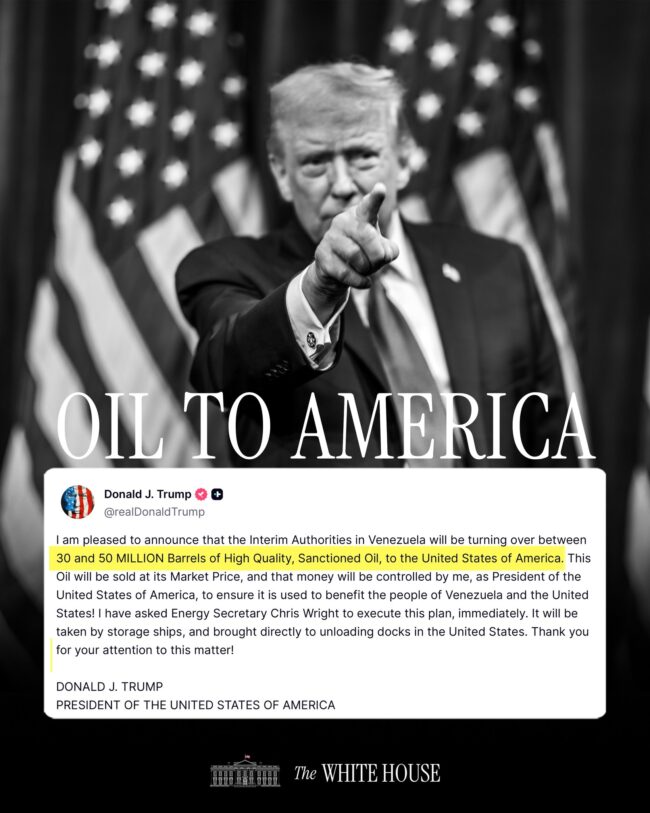
“I am pleased to announce that the Interim Authorities in Venezuela will be turning over between 30 and 50 MILLION Barrels of High Quality, Sanctioned Oil, to the United States of America.”
“This Oil will be sold at its market price, and that money will be controlled by me, as President of the United States of America, to ensure it is used to benefit the people of Venezuela and the United States.”
Trump further revealed that Energy Secretary Chris Wright has been instructed to execute the plan immediately, with the oil to be “taken by storage ships, and brought directly to unloading docks in the United States. Thank you for your attention to this matter!”
The announcement comes on the heels of one of the most extraordinary military actions in recent South American history. U.S. forces captured Venezuelan President Nicolás Maduro and his wife, Cilia Flores, in a daring operation on January 3, 2026.
The couple were flown to New York City where they have appeared in a federal court in Manhattan, pleading not guilty to U.S. federal charges related to narcotics trafficking and weapons conspiracy. A subsequent hearing was scheduled for March 17.
In Venezuela’s capital Caracas, the streets have become a theatre of tension and fierce emotion. Pro-Maduro supporters have marched with portraits of the ousted leader, chanting for his release and denouncing U.S. intervention as theft of Venezuelan sovereignty.
The U.S. itself has witnessed protests in cities like New York, where hundreds marched under banners reading “Hands Off Venezuela” and “US Out”, condemning what they describe as an illegal foreign military incursion.
Venezuelan migrants abroad in places like Doral, Florida, celebrated what they saw as the end of a brutal regime.
Following Maduro’s capture, Delcy Rodríguez, Venezuela’s vice president, was sworn in as acting president by the National Assembly, invoking constitutional succession.
Rodríguez initially denounced the U.S. operation as an “atrocity” and has insisted that Maduro remains Venezuela’s only legitimate president. She has also called for his immediate release.
Rodríguez has expressed willingness to engage diplomatically but has maintained Venezuela’s sovereign dignity.
International reaction has been swift and sharp. Russia condemned what it described as neocolonial threats and backed Rodríguez’s interim government as a bulwark of Venezuelan sovereignty.
Moscow’s Foreign Ministry framed the U.S. strike as external armed aggression, even as it affirmed continued relations with Caracas.
Several Latin American leaders, including Brazil’s President Lula da Silva, criticized the U.S. action as an unacceptable interference in regional affairs, evoking memories of historic foreign interventions in the hemisphere.
At the United Nations, voices from the Security Council expressed deep concern that unilateral military operations undermine international law, stressing that accountability for human rights abuses must not come at the cost of violating state sovereignty.
Trump’s oil announcement describes the transfer as a win-win: Venezuela can benefit from the sale of its oil as well as the U.S. But critics have dubbed the move “oil grab” and likened it to a return of Cold War-era resource politics.
Some analysts warn that, while short-term oil flows might be profitable, the underlying political instability and domestic unrest in Venezuela could undercut any long-term gains.
Maduro, from a U.S. courtroom, has defiantly declared he remains the legitimate president of Venezuela a stance echoed by many of his supporters back home.
The unfolding court battles, international protests, and diplomatic firestorms lay bare a stark truth: what began as a bold American geopolitical maneuver has dramatically reshaped the narrative of power and legality.
