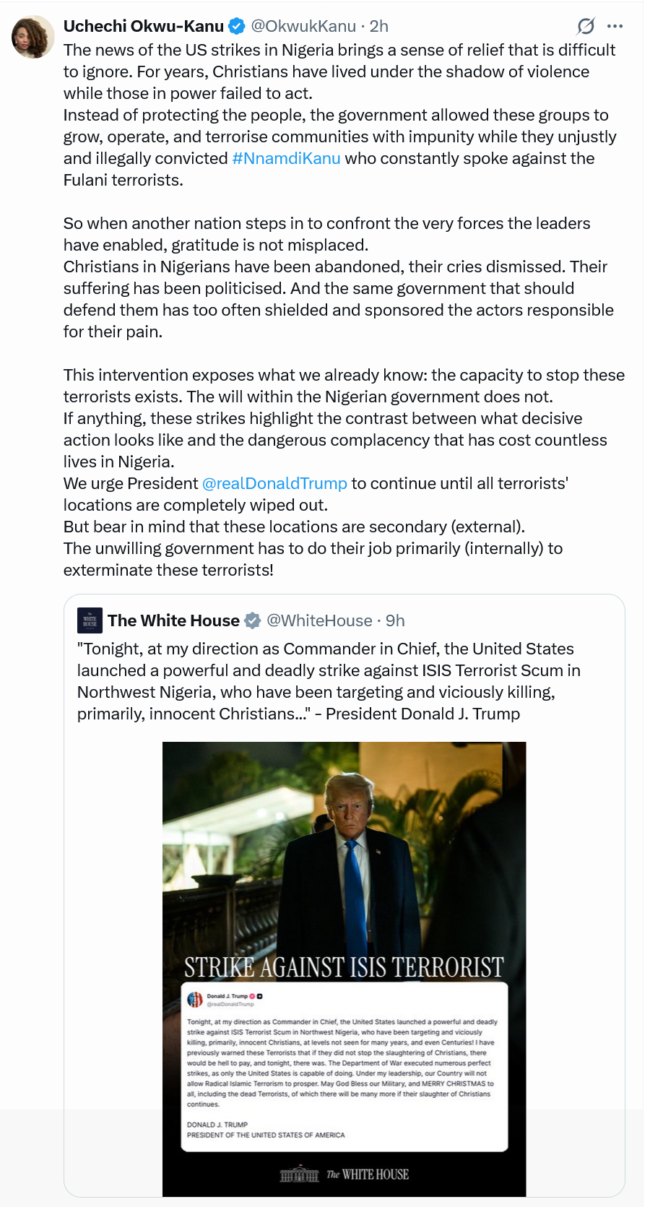
Uchechi Okwu-Kanu Hails U.S. Airstrikes as Last Hope, Blasts Nigerian Inaction
Abuja, Nigeria – December 26, 2025
Uchechi Okwu-Kanu has reacted to news of the U.S. airstrikes against terrorists in northwest Nigeria.
According to her, it “brings a sense of relief that is difficult to ignore. For years, Christians have lived under the shadow of violence while those in power failed to act.”
In her response, she argued that “Instead of protecting the people, the government allowed these groups to grow, operate, and terrorise communities with impunity, while they unjustly and illegally convicted Nnamdi Kanu, who constantly spoke against the Fulani terrorists.”
Mazi Nnamdi Kanu is a vocal critic of the violence ravaging Christian communities and has long warned of the grave danger posed by Fulani terrorism to Nigerians. However, in 2015, the Nigerian government first kidnapped him and detained him unlawfully for two years.
Shortly after his release, state forces invaded his home in Afaraukwu Ibeku in what was widely described as a failed assassination attempt, an operation that left at least 27 people dead and forced him into exile.
Despite surviving this episode of state terror, the Nigerian government later kidnapped him from Kenya in June 2021 and has since ignored multiple court rulings, including a judgment of the Abuja Court of Appeal that discharged and acquitted him, as well as a United Nations ruling declaring his abduction and detention illegal.
On November 20, the Nigerian government sentenced him to life imprisonment, a decision that triggered widespread outrage, with many describing the judgment as the height of lawlessness.
Okwu-Kanu did not mince words in commending the U.S. government strike against Nigerian terrorists. To her, “when another nation steps in to confront the very forces the leaders have enabled, gratitude is not misplaced.”
“Christians in Nigerians have been abandoned, their cries dismissed. Their suffering has been politicised. And the same government that should defend them has too often shielded and sponsored the actors responsible for their pain.”
The recent intervention, she said, only underlined a truth too obvious to ignore: the terrorist groups operating in Nigeria are not invincible and that their continued dominance is exposes that “the capacity to stop these terrorists exists, but the will within the Nigerian government does not.”
She described the intervention as a stark exposure of what effective leadership looks like in contrast to what she termed Nigeria’s long-standing and deadly complacency, a painful reality “that has cost countless lives in Nigeria.”
Okwu-Kanu urged President Donald J. Trump to sustain the military pressure until all identified terrorist locations are completely wiped out, arguing that half-measures only embolden violent actors. However, she was careful to draw a crucial distinction, noting that these foreign-led strikes address only secondary, external locations of terror networks.
In her view, the other part of the battle lies within Nigeria itself. She insisted that no amount of foreign intervention can substitute for a serious internal commitment by the Nigerian government to dismantle terror cells, cut off logistical support, and confront those who enable violence from within the system.
Describing the government as “unwilling,” she maintained that exterminating terrorism must encourage with honest, internal action.
The U.S. intervention comes amid an escalating nightmare of abductions, mass kidnappings, and executions that have scarred the nation’s conscience.
In recent months, armed groups have stormed schools and villages, abducting hundreds of children, including more than 300 pupils from St. Mary’s School in Niger State, where survivors recount terror and uncertainty about ever returning to classrooms.
In other attacks, Christian worshippers were seized during services, and entire communities were emptied as fear spread like wildfire across states that struggle daily with insecurity.
Human rights observers warn that these brutal patterns of violence, including the execution of clergy held hostage along side his wife and daughter, have reshaped Nigeria into a landscape of sorrow and peril.
Against that backdrop of escalating carnage, Okwu-Kanu’s message to President Donald Trump was uncompromising. For her, the contrast between decisive foreign military action and domestic complacency could not be clearer, and it has finally laid bare what true commitment to human life and dignity should look like.
If anything, the strikes have crystallised a bitter truth that Nigerians like Okwu-Kanu have long felt: when the state fails its citizens, the world may be compelled to intervene, but the quest for peace, justice, and genuine accountability at home must begin within Nigeria’s own borders.
Her statement has resonated widely among Nigerians who see the U.S. strikes not just as a military event, but as an indictment of years of inaction, denial, and selective justice.
For Okwu-Kanu, the moment represents both a warning and an opportunity: a warning that complacency is deadly, and an opportunity for Nigeria to finally prove that the protection of lives matters more than politics, alliances, or silence.