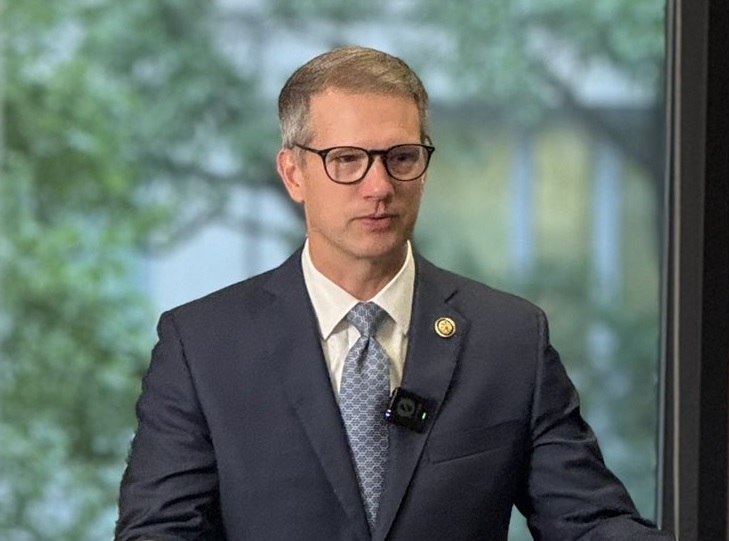
U.S. Congressman Riley Moore Describes “Unimaginable Atrocities” Against Benue Christians, Calls Crisis a Genocidal Emergency
Washington, D.C. – December 10, 2025
Following his visit to several Internally Displaced Persons (IDP) camps in Nigeria, U.S. Representative Riley Moore has delivered a striking account of the suffering endured by Christian communities in Benue State, Nigeria.
In a statement shared on social media, Moore recounted meeting dozens of survivors who were violently uprooted from their ancestral homes and now live with injuries, trauma, and profound loss, adding renewed international attention to the ongoing Christian Genocide in Nigeria.
Moore detailed a series of testimonies he described as “harrowing stories that will remain with me for the rest of my life.”
Among them was “one woman was forced to watch as they killed her husband and five children. She, and her unborn child, barely escaped.”
“Another woman’s family was murdered in front of her and her baby was ripped from her womb.”
Moore added the account of a man whose “One man’s family was hacked to death in front of his eyes and his armed was permanently mangled,” forever bearing the imprint of the attack.
According to Moore, alarmingly more than 600,000 Christians are currently living in Internally Displaced Persons (IDP) camps in Benue State alone, displaced by continuing attacks widely attributed to armed Fulani terrorists.
He described the situation as one where entire communities have been “driven from their homes and subjected to horrific violence,” noting that the scale of atrocities defies any description short of genocidal intent.
At least 10 million Nigerian Christians are Internally displaced and are living in IDP, according to a recent report. Some of the camps have been bombed by the Nigerian Airforce in the past, putting their lives in even more danger.
Moore echoed what many human rights organizations have argued for years: that these Christian populations should be able to live in their ancestral homelands without fear of extermination, especially at the hands of genocidal Fulani.
The congressman’s remarks add moral and political weight to calls for international intervention, accountability, and a reassessment of how global institutions respond to religious persecution in Nigeria.
During his first term, former U.S. President Donald Trump designated Nigeria as a Country of Particular Concern (CPC), placing the nation on a list reserved for the world’s most severe violators of religious freedom.
The designation, however, was short-lived; President Joe Biden removed Nigeria from the CPC list immediately upon taking office, a decision widely criticized by global religious freedom advocates who pointed to the escalating and well-documented mass killings of Nigerian Christians.
After sustained pressure from lawmakers, rights groups, and survivor testimonies, the United States has once again restored Nigeria to the CPC category, once again under Donald J. Trump. The move strengthens Washington’s diplomatic leverage to compel Nigerian authorities to confront what the world increasingly describe as an unfolding genocide.
U.S. officials have privately warned that if Nigeria fails to halt the killings, Washington may consider more forceful measures, including military action to “annihilate” the terrorist networks responsible.
The Nigerian government has reacted sharply to Washington’s renewed scrutiny. While downplaying the scale of the violence, Abuja has rejected the characterization of the crisis as a Christian genocide, stating that insecurity affects more than just Christians, pointing at the moderate Muslims who were slaughtere by jihadists for being too moderate and accommodating of Christians.
Nigerian officials have repeatedly resisted international pressure, insisting that no religious group is being systematically targeted despite mounting evidence to the contrary and years of consistent patterns in the attacks.
This defensive posture from Abuja contributed to the decision by several U.S. lawmakers, including Rep. Riley Moore, to travel to Nigeria for on-the-ground assessments.
Moore’s testimony following his visit to Benue State underscores what many analysts and human rights monitors have documented for over a decade: that the violence is highly targeted and genocidal in nature.
According to the research group Intersociety, no fewer than 7,000 Christians were slaughtered by Fulani Islamist terrorists in just the first half of 2025, adding to a death toll that has already surpassed 52,000 Christian victims since 2009.
Moore’s firsthand accounts, paired with decades of grim statistics, leave little doubt about the scale and intention of the ongoing atrocities.
Survivors in Benue continue to plead for protection, justice, and the conditions necessary to rebuild their shattered communities.
As Moore’s testimony reverberates across global platforms, advocates hope the world will finally confront a crisis long endured in silence by hundreds of thousands of displaced Christian families.
