The Nigerian Senate Approves Troops Deployment to Benin Republic Following Coup Attempt
Abuja, Nigeria – December 9, 2025
The Senate of Nigeria has approved the deployment of Nigerian troops to the neighbouring Benin Republic following an alleged thwarted coup attempt, a decision that highlights Abuja’s readiness to intervene militarily in the region to protect Western order.
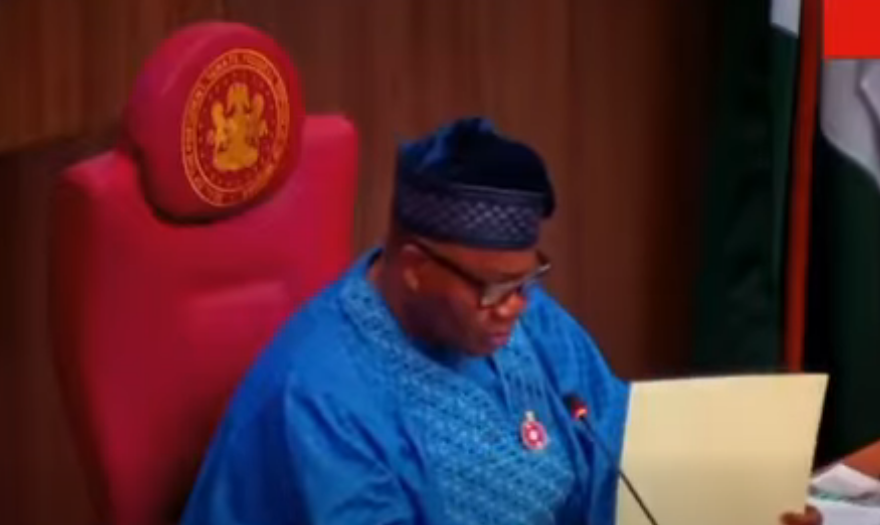
During Tuesday’s plenary session, Senate President Godswill Akpabio disclosed that lawmakers had formally endorsed the President’s request after examining it in a full committee session, under Section 5, Part II of Nigeria’s Constitution.
The move comes as a response aimed at imposing the Nigerian government’s idea of stabilization in Benin after a dramatic and dangerous invasion over the weekend.
The chamber offered unanimous consent, giving the federal government the legal authority it needed to proceed with the deployment of Nigerian troops to Benin Republic. The resolution, once dispatched to President Bola Tinubu, will activate the next phase of the intervention.
In the early hours of Sunday, 7 December 2025, a group of soldiers in Benin by the name of the Military Committee for Refoundation (CMR) appeared on state television in the capital, Cotonou.
They declared the dissolution of the government, announced the removal of President Patrice Talon and the suspension of all state institutions, effectively declaring a successful coup.
The revolutionaries narrated systemic neglect of soldiers, economic instability, and worsening security conditions in the country.
Gunfire was reported near the presidential residence and other strategic locations, and the national broadcaster was commandeered.
However, Nigeria and French forces loyal to Patrice Talon quickly mobilized. By Sunday evening, the two governments in collaboration with Talon’s loyalists declared the coup attempt foiled.Stating that the coup plotters were flushed out, the broadcasting system retaken, and normal order largely restored. Arrests of several soldiers involved reportedly followed.
The following day, Nigeria’s President Bola Ahmed Tinubu despite declaring the coup attempt foiled submitted a formal request to the Senate to deploy Nigerian troops in Benin, citing an official appeal from the Beninese government for “exceptional and immediate” air and ground support to quell the threat and protect democratic institutions.
During plenary session, Senate President Godswill Akpabio read the request, which referred to constitutional provisions governing foreign deployments. The measure was committed to the committee for immediate action, effectively greenlighting the operation.
Nigerian air force jets were reportedly deployed to Benin’s airspace, and Nigerian ground forces began arriving under the framing of the Benin government’s request.
Nigeria’s swift intervention drew both domestic and regional attention. In Abuja, some political voices praised Tinubu claiming his actions is an attempt in upholding regional stability; others criticised what they called a quick-response standard applied to foreign affairs but inconsistently to Nigeria’s domestic security issues.
“The interference by the Nigerian government is an attempt to assert dominance and interfere in Benin’s sovereign internal affairs. Breaching territorial integrity of African countries is an action Nigeria has conducted with impunity since 2021 when they abducted Mazi Nnamdi Kanu, a British citizen from Kenya,” Sochima Mbanali stated.
On Monday, Nigeria escalated tensions with Confederation of Sahel States (AES) which includes Mali, Niger, and Burkina Faso when the Nigerian Air Force C-130 entered Burkina Faso airspace illegally.
AES confirmed this as a “major security breach” following the forced landing of the Nigerian Air Force C-130 aircraft at Bobo-Dioulasso Airport, detaining the entire 11 crew members.
ECOWAS announced immediate activation of its “Standby Force” to intervene in Benin in to ensure Western order. Troops from Nigeria, Sierra Leone, Côte d’Ivoire, and Ghana were mobilized as part of the intervention.
In the past year ECOWAS has witnessed significant lose of power as it has been severally accused of pushing western agenda against the interest of member states. Mali, Niger, and Burkina Faso had exited the union in January 29, 2025, despite appeals for them to stay.
ECOWAS claims the deployment was made under the provisions of ECOWAS’s 1999 Protocol on Conflict Prevention, Management, Resolution, Peacekeeping and Security.
In a region rapidly turning away from Western influence, Nigeria’s swift military intervention, backed by France, signals their readiness to defend western influence with force. The episode may mark a turning point in how West African nations respond to breach of territorial integrity.
Nigeria’s Regional Leadership Tested
Nigeria’s readiness to deploy troops abroad, particularly in a neighbouring state, demonstrates both assertiveness and a willingness to continue in its leadership position in regional security.
However, critics warn that such interventions carry long-term responsibilities and shows unwillingness to solve it’s own insecurity, especially given Fulani terrorism, especially in the North against Christians.
RAMIFICATIONS for Regional Bloc Politics
Akpabio framed the approval as an essential step for the region, warning that instability in any neighbouring state ultimately threatens the collective peace of West Africa.
Political analysts say that the deployment may destroy any credibility left to ECOWAS after recent criticism of its handling of the change in government in Niger, Burkina Faso, and Mali.
It also risks deepening fractures: some Sahel states that have exited ECOWAS or aligned with alternate regional blocs may view Nigeria’s role and ECOWAS’s intervention as intrusive or destabilizing.
Precedent for Future Interventions
This intervention may set a precedent for how constitutional crises are handled in the region, if Nigeria is successful in Benin it will possibly embolden governments to call on foreign troops when domestic cohesion breaks down.
This raises complex questions about sovereignty, regional solidarity, and the risk of external actors shaping internal outcomes.
The Nigerian Senate’s rapid approval of troop deployment to Benin following the coup attempt marks a dramatic moment for West African regional politics. With fighter jets already in action and troops mobilized under the cover of ECOWAS, the intervention underscores a renewed commitment, at least by some states, to uphold western order by force.
Whether this episode will deter future coups or contribute to an arms-heavy approach to governance remains to be seen. What is clear, however, is that the stakes have risen: in a region where the stability of one country quickly impacts its neighbors, the lines between internal politics, regional security, and foreign intervention have never been more blurred.
