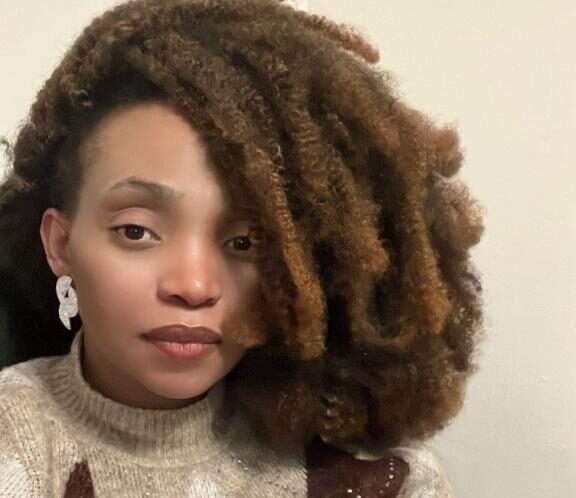
“The Military Are The Jihadists’ Sympathisers.”
Lolo Uchechi Okwu-Kanu Questions Why Troops Arrived Only After At Least 162 Were Killed in Woro and Nuku Despite Prior Warnings
London, United Kingdom — A blistering social media intervention by Lolo Uchechi Okwu-Kanu, wife of illegally detained IPOB leader Nnamdi Kanu, has reignited national outrage over Nigeria’s spiraling insecurity, following the massacre of at least 162 people in the rural communities of Woro and Nuku in Kwara State.
In a statement that has since rippled across social media platforms, Okwu-Kanu accused the Nigerian military of grave complicity, arguing that its repeated pattern of no, or at best, late intervention amounts to silent sympathy for jihadist terrorism rather than protection of citizens.
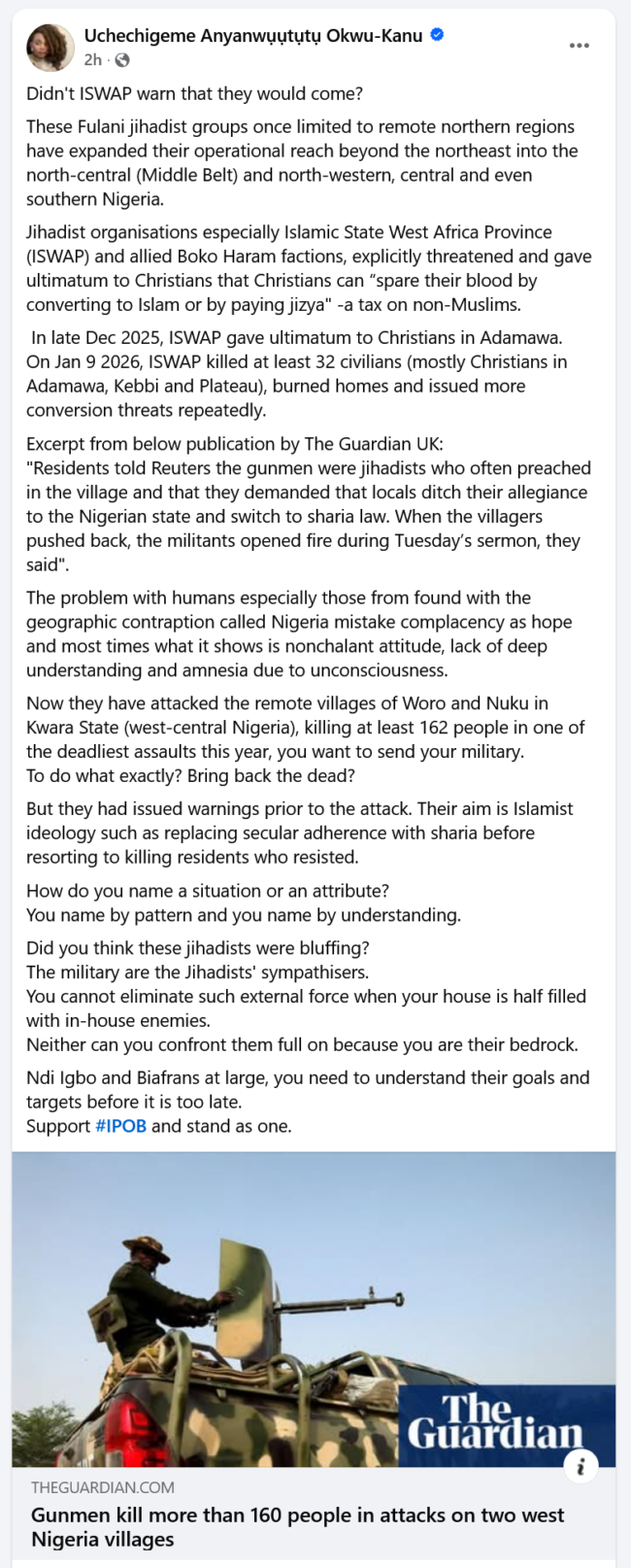
Titled “Didn’t ISWAP warn that they would come?” she decried that “these Fulani jihadist groups once limited to remote northern regions have expanded their operational reach beyond the northeast into the north-central (Middle Belt) and north-western, central and even southern Nigeria.”
Peoples Chronicles had reported on the notorious attack on Woro and Nuku communities in Kwara State that saw the massacre of at least 170 people with numbers still on the rise as at the time of the report.
“Support IPOB And Stand As One,” she reiterated, as her comments come amid growing evidence that terrorist groups, particularly the Islamic State West Africa Province (ISWAP) and allied Boko Haram factions, have long signaled their intent to expand attacks across the country.
“Jihadist organisations especially Islamic State West Africa Province (ISWAP) and allied Boko Haram factions, explicitly threatened and gave ultimatum to Christians that Christians can “spare their blood by converting to Islam or by paying jizya” -a tax on non-Muslims,” Okwu-Kanu wrote.
Security analysts have repeatedly noted that ISWAP has adopted a strategy of issuing ideological ultimatums before launching assaults.
“In late Dec 2025, ISWAP gave ultimatum to Christians in Adamawa,” she noted.
“On Jan 9 2026, ISWAP killed at least 32 civilians (mostly Christians in Adamawa, Kebbi and Plateau), burned homes and issued more conversion threats repeatedly.” The pattern, critics argue, was clear and escalating.
Okwu-Kanu cited an excerpt from a Guardian UK report, which confirmed that “Residents told Reuters the gunmen were jihadists who often preached in the village and that they demanded that locals ditch their allegiance to the Nigerian state and switch to Sharia Law. When the villagers pushed back, the militants opened fire during Tuesday’s sermon, they said”.
“But they had issued warnings prior to the attack. Their aim is Islamist ideology such as replacing secular adherence with sharia before resorting to killing residents who resisted.”
Yet despite these signals, the attack on Woro and Nuku proceeded unhindered. The assault now stands as one of the deadliest this year in Nigeria.
The wife of the IPOB leader questioned why security forces consistently arrive only after villages have been emptied by death. “To do what exactly? Bring back the dead?”
Okwu-Kanu described the tragedy as more than a security failure, describing it as a symptom of institutional complacency and selective urgency.
“Did you think these jihadists were bluffing? The military are the Jihadists’ sympathisers.”
She warned that repeated nonchalance by authorities has been dangerously misread by citizens as hope, when in reality it reflects deep systemic decay.
“You cannot eliminate an external force when your house is half-filled with in-house enemies,” she wrote, suggesting that infiltration, ideological alignment, or willful negligence within state institutions has crippled any genuine counterterrorism effort.
Her remarks also widened the lens beyond Kwara, calling on Ndi Igbo and Biafrans to recognise the ideological war playing out across Nigeria, one that targets communities in phases while the state remains either overwhelmed or unwilling to act decisively.
Political observers say the statement resonates because it mirrors a recurring national pattern: advance warnings ignored, communities left exposed, mass killings executed, and military denies or deploys only after public outrage erupts.
As Nigeria buries yet another set of victims, the questions raised by Okwu-Kanu refuse to fade. If threats are known, patterns established, and ideologies declared in advance, why does protection arrive only after the blood has dried?
For many Nigerians, Woro and Nuku are no longer isolated tragedies. They are grim markers in a widening map of insecurity, and to critics of the state, further proof that the crisis is not only about the presence of jihadists, but about the silence, delay, and denial that surround them.
Related Articles:
Peace for Whom? Katsina’s Dangerous Excuse for Freeing 70 Suspected Terrorists
Death Sentence for Self-Defense Exposes Why Nigeria Is a Failed State
