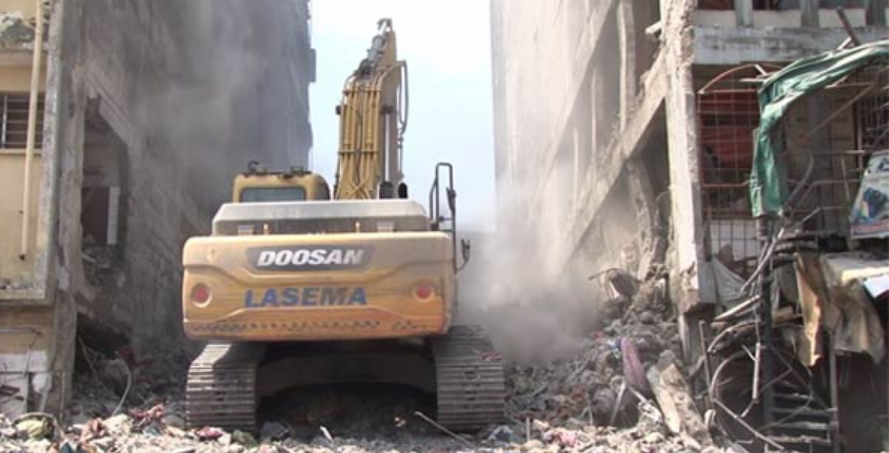
Outrage Over Forced Demolition, Teargas at Balogun Market in Lagos
Lagos, Nigeria – January 8, 2026
Widespread outrage has erupted following the security forces and government officials forcefully demolishing traders’ shops at Balogun Market, Lagos State, a market largely dominated by Igbo traders in Nigeria’s commercial capital.
The demolition, carried out without prior notice, has been condemned as cruel, provocative, and ill-timed, coming barely days after a devastating Christmas Eve fire that razed a 25-storey commercial building in the same market, killing scores, wiping out livelihoods, and trapping over twenty people still.
Eyewitnesses in the videos recount a grim scene. As some business people demanded explanations for the sudden demolition, police operatives released tear gas, and violently dispersed the crowd, sending men and women running for safety. Some traders reportedly sustained injuries in the chaos.
The footage captures panic-stricken voices and clouds of tear gas hanging over what should have been a centre of commerce, not conflict.
Bystanders lamented that many shop owners were still in the South-East celebrating the festive season, completely unaware that their businesses were being reduced to rubble in their absence, by a government that is supposed to protect their businesses.
The Balogun Market demolition has reopened deep wounds, especially among Igbo communities, following the Christmas eve inferno that engulfed the multi-storey commercial complex.
That fire, which claimed lives and destroyed goods worth billions of naira, has been widely alleged to be deliberate, and follows the pattern of the destruction of Igbo businesses in Lagos, though authorities have yet to present a transparent, independent account.
Nigerians across ethnic and religious lines sharply criticised the government’s response to that tragedy, describing it as slow, dismissive and lacking empathy for the victims, many of whom were trapped in the blaze.
Against this backdrop, the sudden demolition at Balogun Market is being viewed not as an isolated urban enforcement action, but as part of a disturbing sequence of events targeting Igbo economic spaces in Lagos.
Traders and civil society voices argue that the absence of notice, dialogue or relocation plans betrays a punitive mindset, rather than a government genuinely committed to regulation and public order.
Perhaps the most painful aspect of the unfolding tragedy is the timing. As many Igbo traders travelled east to mark Christmas and New Year with their families, their shops were reportedly destroyed in their absence, turning what should have been a season of reunion into one of grief and financial ruin.
“People are eating rice in their villages, not knowing bulldozers are eating their life savings in Lagos,” one witness said in the video, his voice shaking with anger. “What type of government derives joy in the continued subjugation of it’s citizens?” another asked, clearly disappointed.
The demolition has also heightened fears among traders who see their businesses not just as shops, but as decades of sweat, sacrifice and migration-earned survival in a city they helped build economically.
To them, Balogun Market is not merely real estate; it is a symbol of inclusion in Nigeria’s commercial heartbeat.
Across social media and public discourse, Nigerians have condemned what they describe as state brutality, economic persecution and ethnic insensitivity.
Critics question why enforcement actions are carried out with armed police and tear gas against unarmed traders, instead of through civil processes and humane engagement.
As the dust settles over Balogun Market, one question echoes louder than the gunshots heard in the videos: Who protects the citizens when the state itself becomes the source of fear?
Until clear answers, accountability and redress emerge, the images from Balogun will remain a haunting reminder of a nation struggling to reconcile power with justice, and governance with humanity.
