
Nigeria Backs Somalia, Warns World Against Recognising Somaliland Independence
Abuja’s claim of commitment to Somalia’s sovereignty and territorial integrity has been met with skepticism, with critics arguing that Nigeria lacks the moral standing to caution against recognising breakaway regions, given its own record of actions that have inflamed tensions and contributed to instability rather than preventing it.
Abuja, Nigeria – December 28, 2025
The Federal Government of Nigeria has firmly restated its support for the territorial integrity and unity of the Federal Republic of Somalia, warning international actors against recognising Somaliland as an independent entity.
In a press release issued by the Ministry of Foreign Affairs in Abuja on Saturday, 27 December 2025, Nigeria claims it remains unwavering in its commitment to the core principles of sovereignty, territorial integrity, and political independence of all member states of the United Nations and the African Union, as enshrined in the UN Charter and the Constitutive Act of the AU.
The statement declared Nigeria’s “firm and unequivocal support” for the sovereignty, unity, and statehood of Somalia, stressing that the Government of Somalia remains the legitimate authority representing the Somali people.
Abuja also commented on worsening insecurity in Mogadishu, framing it as government’s continued efforts toward peace, security, and national reconciliation.
Nigeria further condemned any actions or rhetoric that undermines the colonial structure of Somalia, claiming that such moves threaten not only Somalia but the wider stability of the Horn of Africa.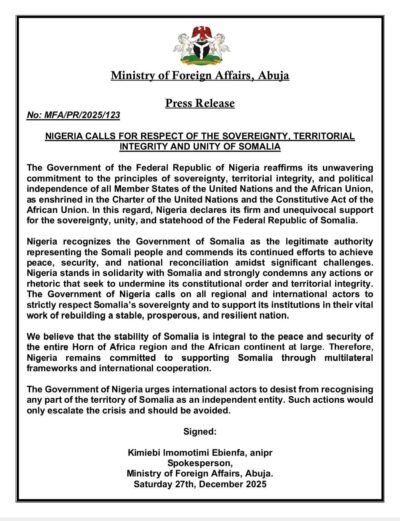
The Ministry underscored Nigeria’s solidarity with Somalia and reiterated its commitment to supporting the country through multilateral frameworks and international cooperation aimed at rebuilding a stable, prosperous, and resilient nation.
In a direct warning to global actors, the Federal Government urged the international community to desist from recognising any part of Somali territory as an independent state, cautioning that such actions would only escalate tensions and deepen the crisis.
The statement was signed by the spokesperson of the Ministry of Foreign Affairs, Kimiebi Imomotimi Ebienfa, reaffirming Nigeria’s long-standing foreign policy position in defence of African unity and internationally recognised borders.
Critics of Nigeria’s position argue that the stark contrast between insecurity in Somalia and the relative stability of Somaliland is precisely why international recognition of Somaliland has become unavoidable.
While Mogadishu continues to grapple with persistent terrorism and fragile institutions, Somaliland has, for more than three decades, maintained its own government, secured its territory, conducted elections, and kept extremist violence largely at bay.
To these critics, recognition is not a reward for secession but an acknowledgement of political reality, governance capacity, and the right of a people who have demonstrably built order where chaos once reigned.
They contend that continued denial of recognition only punishes stability and incentivises dysfunction.
The same critics turn their lens inward toward Nigeria, questioning its moral authority to lecture others on sovereignty and stability after it allegedly violated Kenya’s territorial integrity in 2021 by abducting and forcibly transferring the leader of the Indigenous People of Biafra (IPOB), even as the country continues to battle its own deepening security crisis.
From Fulani terrorism across the country and rampant criminality across the federation, Nigeria’s inability to secure lives and territory has become a defining national weakness.
In this context, critics argue that Abuja’s foreign policy posture rings hollow, portraying a state struggling to govern itself as an arbiter of unity elsewhere.
To them, Nigeria’s unresolved insecurity undermines its credibility, raising uncomfortable questions about whether sovereignty without security is truly worth defending.
