Niger Tightens Border Controls on Nigerian Goods After Regional Security Tensions
Niger – December 9, 2025
The Republic of Niger has formally activated a new security protocol imposing systematic inspections on all goods arriving from the Federal Republic of Nigeria, with special attention to consignments labelled “miscellaneous.”
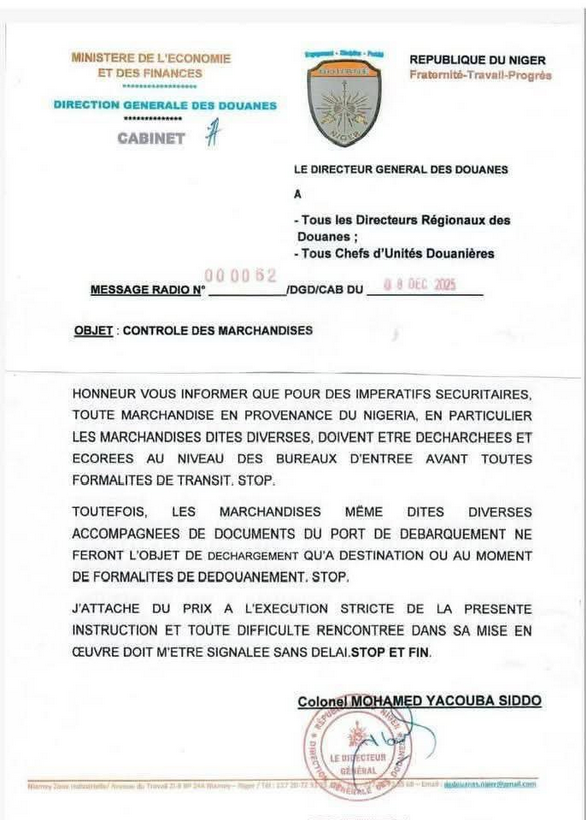
An official circular issued by Colonel Mohamed Yacouba Siddo, Director-General of Customs, obtained by PEOPLS CHRONICLES, confirms the new measures, citing “security imperatives.”
This development occurs against the backdrop of rising geopolitical friction between Nigeria and the Confederation/Alliance of Sahel States (AES), the military bloc formed by Niger, Mali, and Burkina Faso. It follows two major incidents that have reshaped regional security calculations:
- Nigeria’s military intervention in Benin that claims to have foiled a coup attempt in the country.
- The forced landing of a Nigerian Air Force C-130 in Bobo-Dioulasso after AES accused Nigeria of violating confederate airspace.
Together, these events have triggered a coordinated Sahelian security response to Nigeria’s disregard to territorial integrity of African countries. It is expected that Nigeria’s military movements, economic flows, and cross-border influence will be under intensified scrutiny.
What the Official Niger Customs Document Says
The internal customs directive, issued 8 December 2025, states (translated from French):
“For security imperatives, all merchandise coming from Nigeria, particularly goods described as ‘miscellaneous’, must be unloaded and inspected at entry offices before any transit formalities.”
“However, miscellaneous goods accompanied by landing documents will only be unloaded at destination or during customs formalities.”
“Strict execution is required, and any difficulty encountered must be reported without delay.”
This instruction, addressed to all Regional Directors and Unit Chiefs of Customs, represents an immediate and binding order across every controlled entry point into Niger.
Why Niger Is Tightening Controls Now
This tightening of security controls follows Nigeria’s Intervention in Benin’s Coup on Sunday. PEOPLES CHRONICLES had reported that Nigeria deployed troops and air assets to Benin, an attempt to foil the coup.
AES leaders perceive Nigeria’s unilateral military intervention as overreach and a demonstration of Abuja’s willingness to project force deep into the region without regional consensus.
Following Nigeria’s military intervention in Benin, Nigeria’s government deepened suspicions on Monday when its warplane violated AES airspace, after a C-130 military aircraft was intercepted and forced to land at Bobo-Dioulasso, where all soldiers onboard were detained.
Niger, as a co-founder of AES, is now moving in lockstep with its allies to restrict Nigerian military movement, reduce unmonitored trade flows, and assert AES sovereignty.
The new inspection entail mandatory offloading & inspection of all Nigerian goods at entry points, especially those labelled “divers” (“miscellaneous”), a category often used for mixed cargo and sometimes exploited in smuggling or covert logistics operations.
Also, there is instructions for verification of documentation before transit processing. Cargo cannot proceed inland without clearance.
Implications for Trade, Security, and Regional Diplomacy
The implication of this new regulation will affect trade, security, and regional diplomacy. Trade is expected to experience slowdowns & possible higher costs.
Transporters moving goods from Nigeria to Niger should expect longer border delays, possible higher inspection fees, and possible higher insurance premiums for Sahel-bound logistics.
This regulation will also effect new regional power dynamics as AES appears determined to show Nigeria that its borders will be protected, Nigerian military movement will be monitored, the Sahel bloc can act in unison.
This new regulation is an opportunity for strategic rebalancing after years of Nigeria’s dominance in ECOWAS and regional security affairs.
The Niger Republic’s new inspection policy is not a mere bureaucratic adjustment, it is a calculated geopolitical signal that highlights the deepening distrust between Nigeria and the Sahel military bloc, AES’s determination to assert territorial sovereignty, a new era of hard borders and guarded alliances in West Africa.
With a coup attempt in Benin allegedly thwarted by Nigeria and a major airspace clash in Burkina Faso, Niger’s move fits into a coordinated Sahel strategy designed to check Nigeria’s influence and protect the internal security of AES member states.