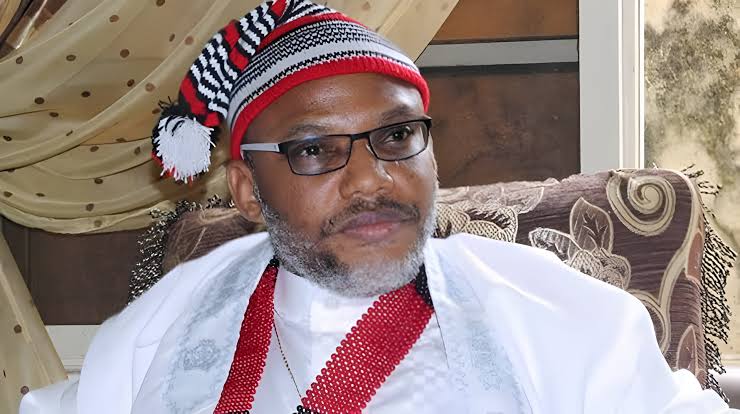
Mazi Nnamdi Kanu Describes Three Types Of Unknown Gunmen Operating in the Southeast, Right Reverend Dr. Ike Egbeonu Reveals
December 3, 2025
In the wake of a judgment widely condemned as one of the darkest moments in Nigeria’s judicial history, new revelations have emerged from an exclusive interview on AIT with the Right Reverend Dr. Ike Egbeonu, Bishop of the Diocese of Orji River.
His account offers a rare window into the private thoughts of Mazi Nnamdi Kanu, leader of the Indigenous People of Biafra (IPOB), a few days after his controversial conviction.
On November 20, the Federal High Court in Abuja sentenced Kanu to life imprisonment after finding him guilty of seven terrorism charges, a ruling met with instant international outrage.
Legal experts, human rights groups, and foreign observers have described the judgment as “evidence of the total collapse of the Nigerian judiciary.”
In an unusually swift move, prison authorities transferred Kanu from the Department of State Services (DSS) facility in Abuja to Sokoto prison overnight, a transfer critics say was designed to isolate him from his legal team, family, and support network.
Despite this, Bishop Egbeonu undertook the long journey to Sokoto to see Kanu personally. What he found was a man deeply wronged, yet remarkably resolute.
According to the Bishop, Kanu expressed confidence that the Appeal Court would overturn what he called an “injustice-filled judgment.”
That faith, coming from a man repeatedly denied due process and openly targeted by the state, struck Nigerians as both shocking and admirable.
It is a reminder that, even in the face of systematic judicial failure, Kanu maintains belief in the power or at least the possibility of the rule of law.
In their conversation, Kanu outlined what he described as “three to four categories of unknown gunmen” operating in the East, a region that has remained, overall, far more peaceful than the narratives pushed by federal authorities.
First, he described a group “imported from outside to destabilize the East so they can tag him with their crimes.” This allegation aligns with long-standing accusations that the federal government have planted violent groups in the region to justify crackdowns on IPOB.
Figures like Asari Dokubo have been repeatedly accused of bringing armed men into Imo and Anambra states, and Dokubo himself has admitted in interviews that the government paid him to deploy his militia to the Southeast.
Second, Kanu identified what he called the “economic unknown gunmen,” profiteers exploiting insecurity for financial gain. In Nigeria’s perverse political ecosystem, insecurity attracts “security votes,” opaque funds that are rarely audited.
Criminal elements, political actors, and arms traffickers all benefit. Nigerian Customs has repeatedly intercepted massive arms shipments, including the July 2, 2024 seizure of N18 billion worth of rifles and drugs imported from Turkey, a stark reminder of the scale of the industry surrounding insecurity.
Third, he pointed to the activities of Simon Ekpa, a Finland-based agitator whose violent sit-at-home orders have crippled economic life in the Southeast. Bishop Egbeonu confirmed that Kanu insisted that he personally wrote a letter to Ekpa, ordering him to stop immediately.
In the letter, made public at that time, Kanu stressed: “I embarked on this movement to liberate our people, not to enslave them.” He condemned actions that “inflict unnecessary hardship on our people,” effectively distancing himself from Ekpa’s violent campaign.
Beyond security concerns, Bishop Egbeonu revealed a troubling legal obstacle. During their meeting, a Consul General repeatedly interrupted to announce that visiting hours had ended.
In those moments, Kanu expressed frustration that Sokoto prison officials had not received instructions to transport him to Abuja for a mandatory court process on November 28, a procedural requirement for filing his appeal ahead of the December 4 hearing. With only a 90-day window to pursue the appeal, delays appear strategic rather than accidental.
Kanu’s case has been mired in controversy since his 2021 abduction and forced return from Kenya, a kidnapping Kenya’s High Court has since declared illegal.
The United Nations Working Group on Arbitrary Detention ruled his rendition and detention unlawful and called unequivocally for his release.
Nigeria’s own Appeal Court amongst others discharged and acquitted him in 2022, ruling his trial unlawful. Yet the government continues to prosecute him, drawing global condemnation.
Inside custody, Kanu faces not only legal persecution but life-threatening neglect. His health, already fragile due to the eight days of torture inflicted during his seizure in Kenya, continues to deteriorate because of denied medical access.
Disturbingly, Bishop Egbeonu confirmed that Kanu’s health challenges persists, particularly his heart issues, and described the condition of his incarceration as “dehumanizing.”
News emerged on October 25 that a DSS official had attacked him while in their custody, and had to be physically restrained by other officers who heard Kanu’s call for help. Despite the public uproar, the officer remains attached to him, and was present in court during the November 20 judgment. No inquiry, discipline, or reassignment followed the attack.
As the world watches Nigeria’s handling of this case, questions mount about the integrity of the judiciary, the weaponization of security institutions, and the intensifying persecution of political dissidents.
Bishop Egbeonu’s account paints a picture not simply of a man wrongfully imprisoned, but of a state apparatus determined to break him, legally, physically, and psychologically.
Yet in the face of all this, Kanu remains unbroken. His faith in eventual justice, whether through the courts or history, may be the only stable truth in a case defined by contradictions, violations, and a government increasingly comfortable defying both local and international law.
This exclusive report underscores the urgency of international scrutiny. As December 4 approaches, the world will once again turn its eyes to Nigeria, waiting to see whether it will double down on injustice, or take a step back from the brink.
