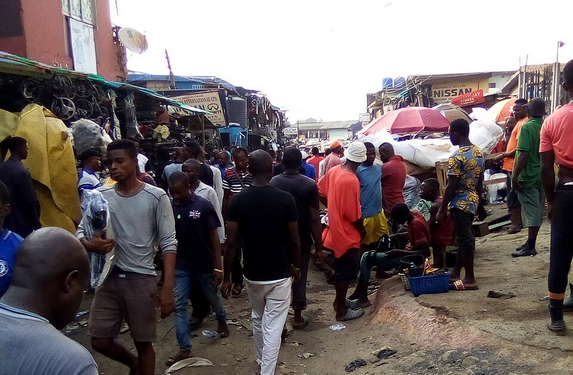
Lagos State Government Seals Ladipo Spare Parts Market Again
Lagos, Nigeria – On Sunday, the Lagos State Government sealed the Ladipo Spare Parts Market, a major commercial hub in Mushin, Lagos, once again deploying force where governance has long been absent.
The closure came without prior notice and was justified by claims of repeated environmental and public safety violations, including the absence of a proper refuse disposal system. Yet this same absence is the direct consequence of years of government neglect, raising serious questions about the logic of punishing citizens for failures rooted in state inaction.
The move was framed as part of Lagos State’s ongoing environmental compliance strategy aimed at curbing sanitation breaches and unsafe commercial practices. Critics, however, argue that it reflects a recurring pattern in which enforcement replaces infrastructure, and coercion substitutes for governance.
Background on Ladipo Market
Ladipo Spare Parts Market, located in the Mushin area of Lagos State, is one of the largest automotive spare parts markets in West Africa.
It attracts buyers, mechanics, and traders from across Nigeria and neighbouring countries and has for decades served as a critical node in the regional automobile supply chain.
Despite its economic importance, the market has developed organically, without commensurate government investment in basic amenities such as waste management systems, drainage, structured stalls, parking facilities, or traffic control mechanisms.
Predictably, this vacuum has produced persistent challenges, including refuse accumulation, congestion, and informal trading spilling onto adjoining highways.
Rather than address these structural deficiencies, authorities have relied on periodic closures and forceful crackdowns, deepening mistrust between traders and the state.
Many traders, largely from Nigeria’s Eastern region, have also faced repeated demolitions of homes and businesses in Lagos over the years, reinforcing perceptions of targeted hostility rather than neutral regulation.
In December alone, tragedy struck at the Great Nigeria Insurance House in Lagos, where over 25 traders reportedly lost their lives in a fire outbreak.
Several victims were trapped in the building for nearly two weeks before their decomposing bodies were recovered, including three brothers from the same family. The incident underscored not just infrastructural decay, but an alarming state indifference to human life and emergency preparedness.
Government’s Rationale for Sealing the Market
Announcing the closure via social media platform X on Sunday, the Lagos State Ministry of Environment and Water Resources, led by Commissioner Tokunbo Wahab, cited persistent environmental infractions.
According to the government, illegal street trading obstructed traffic along major transport corridors, while indiscriminate refuse dumping violated environmental laws.
What remained unaddressed, however, was why a market of such scale operates without a proper state-provided waste disposal framework or designated trading infrastructure in the first place, especially since the Nigerian government have refused to build seaports in other regions of the country to encourage trade.
The closure was enforced by a joint task force comprising multiple agencies, executed under a so-called zero-tolerance policy. Observers note that such policies often translate into collective punishment, disproportionately affecting traders and informal workers who lack political protection.
Enforcement Context and Pattern of State Conduct
The sealing of Ladipo Market follows a familiar Lagos State script. Markets such as Oyingbo, Alayabiagba, and Mile 12 have all been shut down in previous years over alleged sanitation violations, only to be reopened later, without any meaningful infrastructural upgrades, after collecting tens of million in bribery.
This cycle of neglect, enforcement, reopening, and relapse exposes a deeper governance failure. Environmental compliance is demanded, yet the enabling conditions for compliance are never provided.
Traders are expected to obey regulations enforced by officials who themselves preside over the absence of public facilities.
Stakeholder Perspectives
State officials insist that environmental and public safety compliance is essential for urban livability, disease prevention, and traffic management in Africa’s most populous city. Under Governor Babajide Sanwo-Olu, sanitation has been branded a strategic pillar of Lagos’s development agenda.
Traders, however, consistently argue that compliance without infrastructure is an impossible demand. In past closures, they have called for government engagement on waste management systems, market redesign, access roads, and enforcement fairness.
These appeals are routinely ignored, while crackdowns proceed with speed and force, only for markets to reopen after tens of millions have been reportedly paid as bribe.
The result is a governance paradox: citizens are criminalised for survival practices in spaces where the state has failed to plan, build, or maintain.
Conclusion
The sealing of Ladipo Spare Parts Market is not merely an environmental enforcement action; it is a stark illustration of Nigeria’s broader governance crisis.
A state that fails to provide basic facilities, emergency systems, and structured commercial infrastructure cannot legitimately demand compliance through force.
Until Lagos State prioritises investment over intimidation and responsibility over rhetoric, market closures like Ladipo’s will remain symbols of institutional failure disguised as regulation, and citizens will continue to pay the price for a government’s abdication of its most basic duties.
