IPOB Warns of Gov’t Plot to Spark Religious Violence in Biafraland
The Indigenous People of Biafra (IPOB) has raised a fresh alarm over what it described as a sinister and carefully orchestrated plot to plunge Ala-Igbo into renewed violence, particularly through religious unrest aimed at destabilizing the region and discrediting its peaceful self-determination movement.
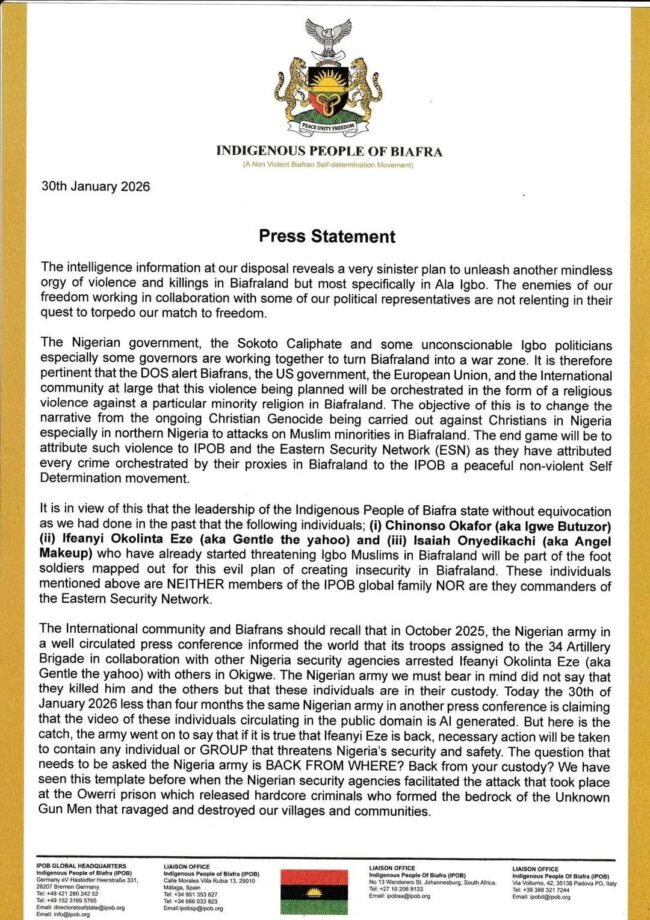
In a press statement dated January 30, 2026, and signed by the Head of the Directorate of State of IPOB, Mazi Chukwukadibia Ezoziem, the group warned that it has obtained intelligence revealing plans to unleash another wave of killings across Biafraland, with specific focus on Igbo territories.
According to IPOB, the scheme involves the Nigerian government, the Sokoto Caliphate, and certain political actors of Igbo origin working together to transform the region into a conflict zone.
The group asserted that the violence is intended to be framed as religious attacks against Muslims in Biafraland, with the ultimate goal of shifting attention away from what it called the ongoing mass killing of Christians in parts of northern Nigeria.
IPOB warned that once such violence erupts, blame would likely be pinned on IPOB and the Eastern Security Network (ESN), despite their repeated stance as a peaceful and non-violent movement.
The organization described this as a familiar tactic used to justify crackdowns and international pressure against its members.
The statement went further to name specific individuals being positioned as “foot soldiers” to carry out threats and provoke unrest. IPOB stressed that these individuals are neither members of IPOB nor commanders of ESN, accusing them of being tools in a broader plan to create insecurity and fear.
Referencing events from October 2025, IPOB recalled a Nigerian army press conference which claimed the arrest of Ifeanyi Okolinta Eze, also known as “Gentle the Yahoo,” in Okigwe alongside others.
The military reportedly stated at the time that those arrested were in custody. However, IPOB questioned recent claims suggesting that videos of the same individuals circulating online were artificially generated.
The group challenged the Nigerian army to explain how someone previously announced as being in custody could suddenly reappear, warning that similar narratives in the past had preceded major security breakdowns, including the controversial attack on the Owerri prison that led to the release of hardened criminals.
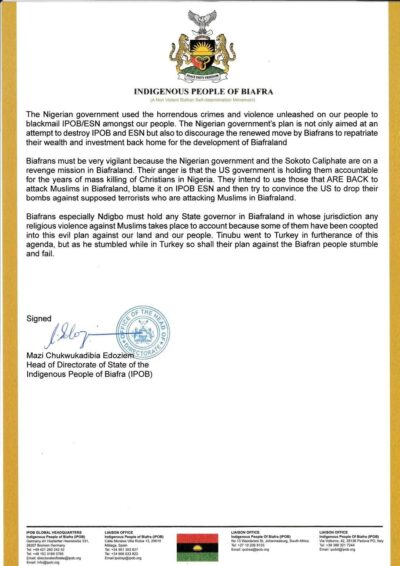
In the second part of the statement, IPOB accused the Nigerian government of using previous violence in the region as a tool of blackmail against IPOB and ESN.
It confirmed the broader objective was not only to weaken the movement but also to discourage Biafrans in the diaspora from returning home to invest in the development of their homeland.
IPOB further stated that anger within Nigerian power structures stems from increased international scrutiny, particularly from the United States, over years of mass killings of Christians.
The group confirmed the plan to target Muslims in Biafraland is designed to manipulate global opinion and shift blame, potentially inviting foreign intervention under false pretenses.
Calling for vigilance, IPOB urged all Biafrans, especially Ndi-Igbo, to closely monitor developments in their communities.
It also demanded accountability from state governors in the region, warning that any religious violence occurring within their jurisdictions should not be treated as coincidence.
The statement concluded with a strong political note, accusing some leaders of being co-opted into the alleged agenda, while expressing confidence that the plot would ultimately fail.
Earlier this year, IPOB signified its decision to intensify its actions against what it described as criminal networks and corrupt political actors in the South-East, publicly targeting a wave of politicians accused of exploiting public office for personal gain.
According to reporting from People’s Chronicles, the group mobilized its media department to be ready to expose their criminal misconduct, arguing that entrenched political interests were undermining governance in the region and exploiting communities for self-enrichment.
Supporters and critics alike have observed that this assertive stance against political criminality may have unsettled certain powerbrokers, potentially motivating a backlash intended to create chaos in Biafraland and shift public blame onto IPOB for any resulting insecurity.
Moreover, critics of the Nigerian government’s handling of security in the South-East have repeatedly pointed to past episodes in which state actors allegedly facilitated instability by sponsoring armed figures and then attributing the violence to IPOB.
One of the most notorious cases involves Ifeanyi Eze Okorienta, widely known by the alias “Gentle the Yahoo,” whose activities in Imo State were linked to organised crime and violent attacks, and who became a figure used in broader narratives about insecurity in the region.
Although official military reports have at times varied in detail, the controversy around Gentle the Yahoo has underscored long-standing accusations that political and security establishments in Nigeria have, fostered or manipulated violent actors and then branded those acts as IPOB/ESN militancy in order to justify harsher crackdowns and shape public perception.
As tensions remain fragile across parts of southeastern Nigeria, the recent press statement has intensified debate online, with supporters viewing clarifications from the military as necessary, and the press statement as a necessary warning, while critics call for independent verification of the allegations.
Related Articles
