IPOB Official Urges Tinubu to Back Referendum
Says Constitutional Reform Should Extend Beyond State Police to Self-Determination Vote
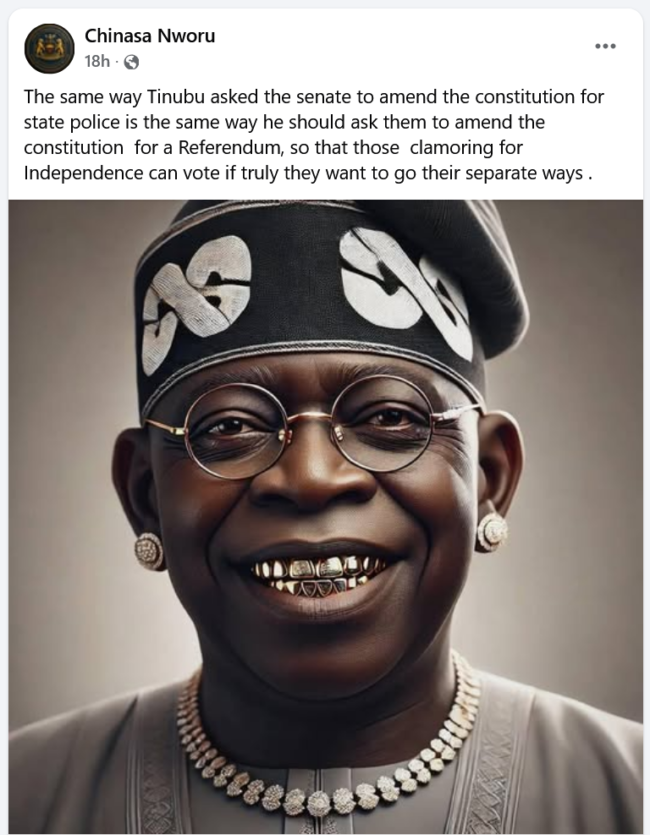
A member of the Directorate of State of the Indigenous People of Biafra, Mazi Chinasa Nworu, has urged President Bola Ahmed Tinubu to demonstrate a broader commitment to democratic principles.
Nworu made the statement on his social media platforms while reacting to the president’s call on the Senate to urgently begin amending the 1999 Constitution to allow for the establishment of state police.
He argued that if the president can request an urgent constitutional amendment for state policing, he should equally seek an amendment to permit the highly sought national referendum.
Such a move, he said, would allow those agitating for independence to determine through a democratic vote whether they wish to remain within Nigeria or pursue self-determination.
According to him, a referendum remains the most viable path toward addressing Nigeria’s worsening insecurity.
“The same way Tinubu asked the Senate to amend the Constitution for state police is the same way he should ask them to amend the Constitution for a referendum, so that those clamoring for independence can vote if truly they want to go their separate ways,” he stated.
Nworu echoed the sentiment of many Nigerians, particularly in the Eastern region, who argue that more than a century after the 1914 amalgamation that brought together diverse regions into one political entity, the country continues to struggle with cohesion and stability.
They trace Nigeria’s governance challenges to what they describe as a flawed historical foundation that fuels persistent political tension.
Other critics share similar concerns. They argue that what they view as a forced union contributed to weak institutions, entrenched corruption, and systemic dysfunction, including within the judiciary that is not left out of the rot.
In their view, these structural issues make the effective enforcement of even well-intentioned reforms difficult if not impossible.
Earlier in the week, an Islamic preacher from a northern community affected by terrorism also voiced his opinion regarding national unity and legal systems.
Nigeria currently operates a dual legal framework, with Sharia law practiced in several northern states alongside secular law applied across the federation.
In his statement, he warned that calls by the United States for the removal of Sharia law in Nigeria, and support for such a move by some Nigerian Christians, could trigger the division of the country. According to him, pursuing a true circular Nigerian state is impossible as the Northern region would rather divide the country than accept.
Nworu’s reaction reflects a broader frustration expressed by many Nigerians who argue that passing laws is only one part of governance. They contend that the deeper challenge lies in the failed institutions that fail to consistently enforcement the laws, as well as lack of political will.
IPOB maintains that without structural change and genuine accountability among political actors, insecurity will persist, insisting that a referendum offers a definitive path forward.