IPOB Encourages Igbo Billionaires to Invest in Agriculture, Commends Christmas Generosity
Bremen, Germany – January 01, 2026
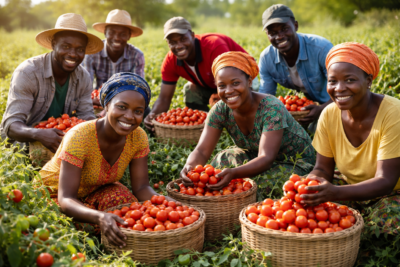
Tomato Farmers
The Indigenous People of Biafra (IPOB) has commended Igbo philanthropists for distributing food items across Igboland during the Christmas season, but urged wealthy Igbos to move beyond palliatives and invest massively in agriculture to achieve food sufficiency.
In a statement issued on Tuesday by its Media and Publicity Secretary, Comrade Emma Powerful, IPOB said while the tradition of sharing food during Christmas was commendable, it could only provide temporary relief.
“The worldwide family and movement of the Indigenous People of Biafra (IPOB) under our esteemed leader, Mazi Nnamdi Kanu, praises Igbo philanthropists for their generosity and provision of food supplies to their community and those in need throughout Igboland during this and every Christmas,” the statement read.
It added, “Ndigbo are recognised for their kindness. IPOB praises all the Igbos who shared food items with others during this Christmas season.”
However, the group stressed the need for a strategic shift from charity to long-term empowerment through agriculture.
“IPOB encourages Igbo philanthropists and affluent Igbos to return to our tradition of teaching individuals how to fish rather than merely giving them fish,” the statement said.
“Biafrans demonstrate creativity and find solutions to challenges. They are recognized for their diligence and self-sufficiency. Ndigbo value learning to fish rather than depending on being given fish.”
According to IPOB, Alaigbo has vast cultivable lands and the human capacity to produce food at scale if there is deliberate investment in mechanised farming.
“With the farming season starting in February and March, we urge affluent Igbos to invest significantly in agriculture. Alaigbo has cultivable lands. We can cultivate a wide variety of crops on a large scale, including the rice and beans that we provide every Christmas,” IPOB stated.
The group also called for investment in livestock farming, including cattle ranching, as a means of ensuring food security and reducing insecurity.
“Ranches can be built, and some young people can be educated in livestock farming like cattle. Having substantial cattle ranches in three or four Eastern states will help prevent scarcity and insecurity caused by the terrorist actions of Fulani herdsmen,” it said.
IPOB said the South-East must aim to meet at least 60 per cent of its food needs through local production.
“Ndigbo requires significant investments in the agricultural sector to achieve food sufficiency or at the very least meet 60 per cent of our food requirements,” the statement noted.
“We applaud those already involved in this field. Farms like Coschris in Anambra that are cultivating rice. This company and others can supply all the rice required for our consumption, export, and distribution throughout Christmas. In doing so, our money circulates throughout the economy.”
It further argued that insecurity should not be used as an excuse for inaction.
“Thankfully, the insecurity situation in the South East is the lowest relative to other regions in Nigeria. Even in the North, despite significant insecurity, they continue to produce food that is adequate for export outside their region. If the unstable North can have mechanized farming (though backed by the Federal Government), then we can promote mechanized agriculture through the communal and volunteer efforts of Ndigbo,” IPOB said.
The group pointed to indigenous manufacturing capacity as an added advantage, citing companies capable of producing agricultural machinery locally.
“We possess the land, we possess the young populace, we possess the market, we possess innovation, and we possess manufacturing firms such as Innoson Industries capable of designing and producing sophisticated agricultural machinery like tractors for mechanised farming,” it stated.
IPOB also referenced its Agriculture Revolution initiative, saying it yielded positive results in 2025.
“Over the last year, IPOB made investments in agriculture by working with various individual farmers. The call produced excellent outcomes. In 2025, there was an abundant harvest of crops such as tomatoes, carrots and onions that were previously regarded as northern-exclusive crops,” the statement said.
It added that the increased production helped stabilise food prices compared to previous years.
Looking ahead, IPOB called on Igbo billionaires and philanthropists to participate in the 2026 farming season and invest in agribusiness and cottage industries.
“IPOB calls on Igbo billionaires and philanthropists to create job opportunities through cottage industries for the youth. These industries will ensure that agricultural produce is processed for domestic consumption and export,” it said.
The group concluded that while distributing food during Christmas and emergencies was admirable, sustainable development required long-term planning.
“Distributing rice and food products is admirable, especially during Christmas, emergencies and times of crisis. This can only offer a short-term respite,” the statement read.
“Equipping people with skills, resources and knowledge promotes enduring self-reliance, dignity and strong communities, moving from dependency to true food security and economic progress.
“We should shift our emphasis from providing free fish to teaching individuals how to fish for themselves. We must enable our rural farmers to transition to mechanized agriculture. With the farming season approaching, it is essential for our people to consciously invest in this crucial sector (Agriculture) for our survival and national security.”
