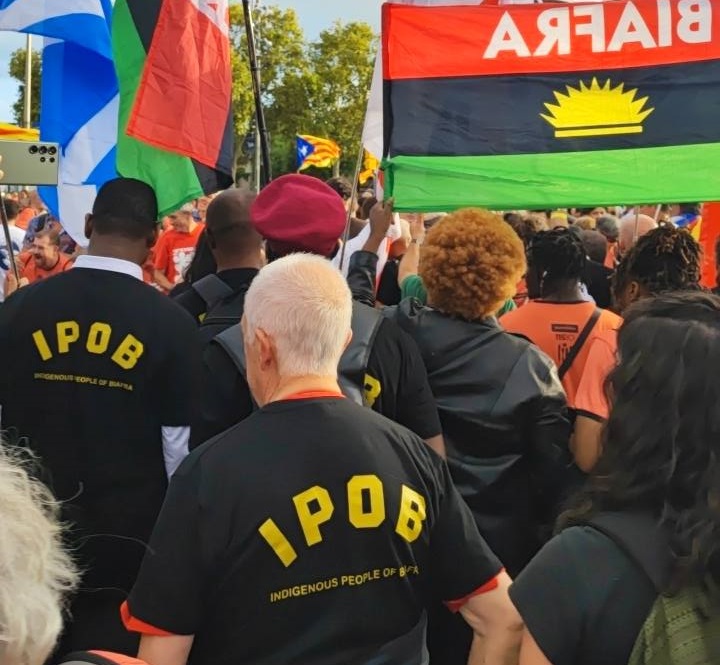
IPOB Demands International Inquiry Into Insecurity In South-East Nigeria
The mass movement accuses Nigerian government of cover-up as tensions deepen
Abuja, Nigeria – January 2, 2026
The Indigenous People of Biafra (IPOB) has renewed calls for an independent, internationally supervised inquiry into the insecurity afflicting the Southeast region, accusing the Nigerian government and military of concealing the true causes of violence and scapegoating the peaceful movement.
IPOB’s demand, issued through its spokesperson Emma Powerful, argues that longstanding instability in the South-East cannot be resolved through unilateral state narratives and military pronouncements.
The group’s statement on January 2, 2026, reiterated a call, first made in earlier petitions and statements, to establish an impartial, judge-led public inquiry under foreign oversight, potentially chaired by a jurist from South Africa to ensure insulation from Nigerian political influence.
Citing claims attributed to Major General Michael Onoja that security conditions in the region have improved since the kidnap of IPOB’s leader from Kenya and sentencing, IPOB countered that such assertions amount to a “cover-up” and recycled propaganda.
The movement urged major international actors, including the United States, United Nations, African Union, and European Union, to support transparent scrutiny of the conflict, including full access to security records and protections for whistleblowers.
This is not the first time IPOB has sought international engagement. Throughout 2025, the group repeatedly called for external investigation, emphasising that local mechanisms have failed to resolve deep-rooted grievances and mounting violence in the South-East.
Earlier in 2025, IPOB’s leadership decried what it saw as anti-Igbo policies and a government media campaign designed to delegitimise its cause while diverting attention from insecurity.
In November 2025, unlawfully detained IPOB leader Nnamdi Kanu authored an open letter to the U.S. President Donald Trump, urging Washington to lead an inquiry into allegations of state-sponsored killings and pervasive human rights abuses in the South-East.
In that correspondence, Kanu linked historical and contemporary incidents, describing the insecurity as part of a broader pattern of persecution and arguing for U.S. congressional hearings on a looming genocide.
IPOB’s appeals have emphasised that independent international intervention is necessary not only to uncover truth but to protect civilians, counter false state narratives, and address perceived impunity.
Previous calls have specifically sought involvement from international human rights bodies and Western governments to validate or challenge conflicting accounts of violence and to ensure accountability.
The Nigerian government’s official position contrasts sharply with IPOB’s assertions.
Military and federal authorities have maintained that security in the South-East has improved due to intensified operations and the detention of IPOB’s leader Mazi Nnamdi Kanu and self-declared agitator Simon Ekpa.
Beyond official statements, Igbos have sharply rejected government narratives, accusing the military of inflating its own successes while obscuring the true roots of insecurity.
Most people from the Southeast described recent claims of reduced violence as an attempt to rewrite history, insisting that the state’s policies have killed Igbo youths citing the notorious Tiger Base police station, while accusing the army of exacerbated tensions rather than alleviating them.
The push for international oversight emerges against the backdrop of deep distrust between Nigerians and state institutions, amplified by competing accounts of responsibility for violence, displacement, and human rights abuses in different regions, especially in Southeast.
IPOB has consistently denied any involvement in violence, arguing instead that government-recruited extremists and agent provocateurs are being used to justify crackdowns on civilian populations.
Nigeria’s security services, have accused its leadership of incitement and violent conduct, charges the Nigerian government could not prove in their own court, and rejected by Igbos who hold that these narratives are politically motivated and serve to distract from broader governance failures.
The call for an international inquiry is more than procedural; it reflects entrenched scepticism about domestic accountability mechanisms and a belief among IPOB supporters that only impartial global scrutiny can bridge competing truths about insecurity in the South-East.
As frustrations grow and staunch appeals for transparency accumulate, the demand for international inquiry crystallises into a focal point of political contention, raising complex questions about human rights, and the role of external actors in resolving Nigeria’s deepest security crises.
The trajectory of these appeals suggests that, absent credible domestic solutions, IPOB may increasingly look beyond Nigeria’s borders for validation of grievances and pathways to justice, making international engagement, whether diplomatic, legal, or investigatory, an unavoidable dimension of the South-East’s future peace prospects.
RELATED STORIES
