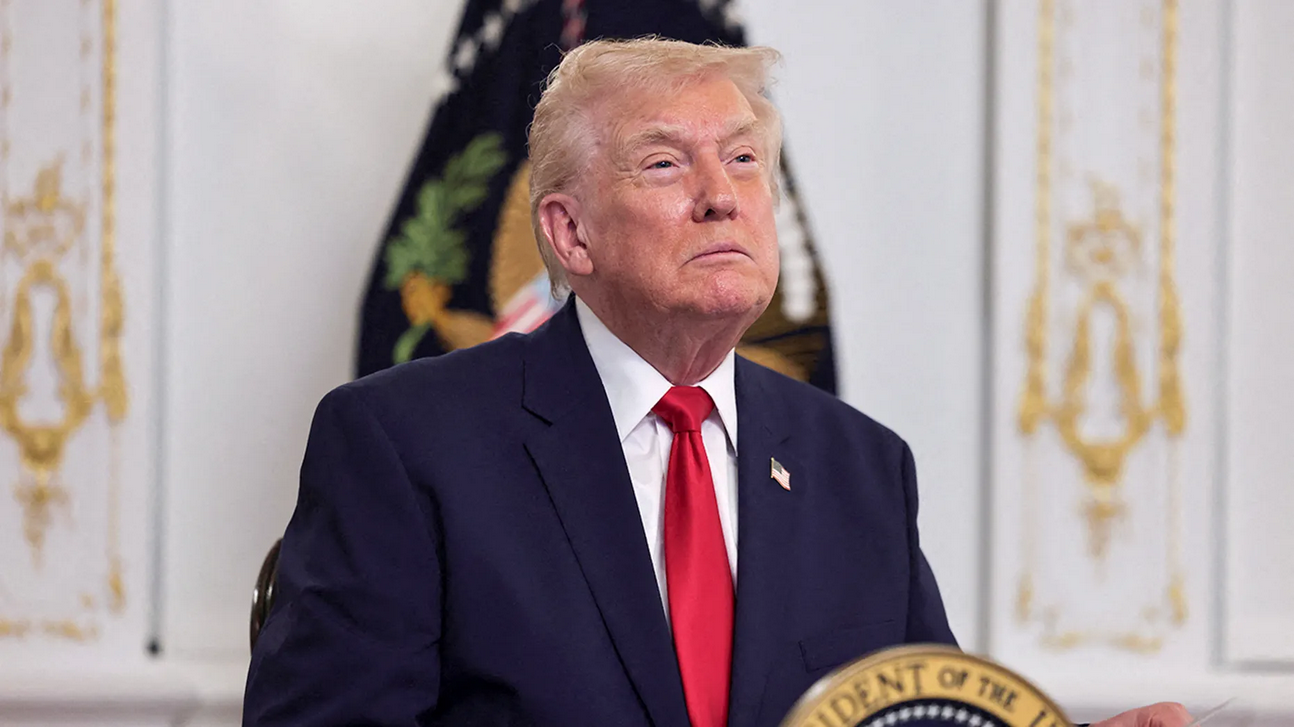
Full Report: US Congress Submits Report on Christian Genocide in Nigeria
Proposes Major Policy Shift on Nigeria’s Security, Arms and Trade to White House
In a sweeping set of proposals released this week, the United States Congress has submitted firm recommendations to the White House, urging that the Federal Government of Nigeria recalibrates its defence, trade, and policy partnerships.
These recommendations are considered important in other to address deep-rooted insecurity, and reassess certain agricultural trade links as part of a broader push to curb violence and protect vulnerable communities.
The recommendations were outlined in a report released on Monday by committee chairman Riley Moore, and formally submitted to the White House by the House Committees on Appropriations and Foreign Affairs following extensive hearings and investigations into persistent Christian genocide in Nigeria.
At the centre of the proposals is a call for Nigeria to divest from Russian military hardware and instead pursue defence cooperation with the United States, which lawmakers say would strengthen Abuja’s capacity to counter Fulani terrorism and protect its citizens.
The report follows President Donald Trump’s recent redesignation of Nigeria as a Country of Particular Concern (CPC) over violations of religious freedom, especially against Christian communities across various regions.
A significant recommendation urges the Nigerian government to reduce its reliance on Russian military equipment and to procure U.S. defence systems through strengthened security cooperation agreements.
Lawmakers argue that American military support and financing arrangements could bolster Nigeria’s response to the threats of Fulani terrorism.
The report also emphasizes enhanced counter-terrorism collaboration, including intelligence sharing and targeted support to dismantle extremist networks threatening both Nigerian stability and U.S. national interests.
In a somewhat unconventional move, the congressional document suggests the U.S. Government consider blocking beef and other cattle-related exports from Nigeria to select regional markets, including Ivory Coast, Ghana, South Africa, and Senegal.
This recommendation is aimed at creating economic pressure to compel Fulani herdsmen to disarm amid ongoing terrorist against Christian Communities and attributed to these groups.
Despite the carnage by Fulani Herdsmen terrorists, the Nigerian government considers Fulani Herdsmen livestock exports as a key component of regional trade, and the proposal reflects an emerging willingness among U.S. policymakers to integrate trade measures alongside security and diplomatic tools in foreign policy.
Beyond defence and trade, lawmakers called for a bilateral agreement between Washington and Abuja to protect vulnerable Christian communities, improve early-warning security systems, expand humanitarian assistance, particularly in internally displaced persons (IDP) camps, and pursue legal reforms.
The list also includes calls to continue visa restrictions on individuals implicated in violence and to push for the repeal of laws seen as exacerbating religious tensions.
Implementation of these recommendations would require coordinated action by the U.S. Administration and sustained diplomatic engagement with Nigeria.
Some of the suggested measures, particularly trade and defence shifts, could deepen ties but also stir debate over Nigeria’s strategic direction especially towards Islamic countries like Turkey and Pakistan.
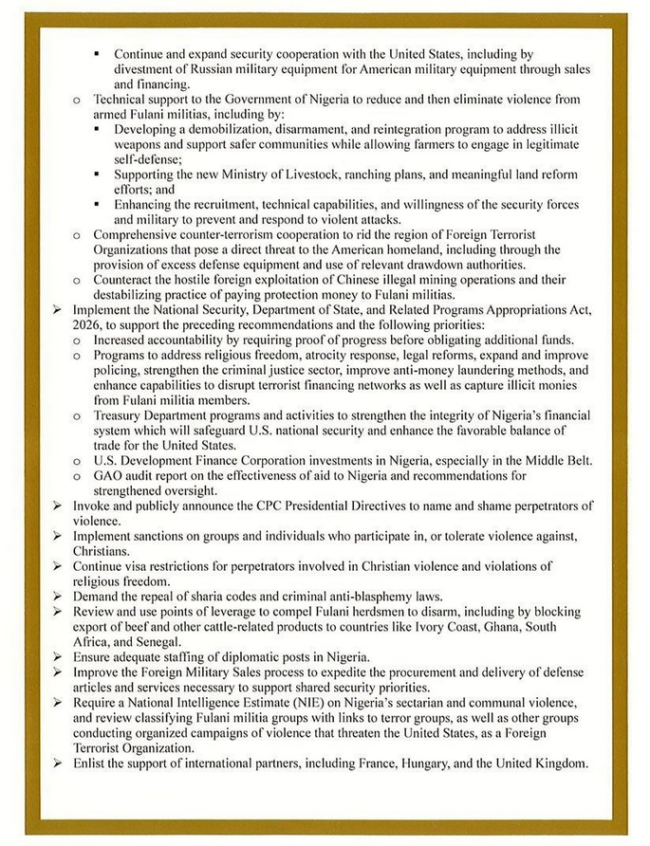
Below is the full text of the two-page report submitted by the panel:
Ending The Persecution of Christians in Nigeria
The United States Congress commends President Trump for his decisive action to redesignate Nigeria as a Country of Particular Concern (CPC) to hold perpetrators of violence to account and compel the Government of Nigeria to protect vulnerable communities and end religious persecution.
The President called on Congressman Riley Moore, Chairman Tom Cole, and the House Appropriations Committee to investigate and produce a report on the persecution and slaughter of Nigerian Christians. To examine the facts, Appropriations Vice Chair Mario Díaz-Balart hosted an investigative roundtable and led a Congressional Delegation to Nigeria and House Foreign Affairs Committee Chairman Brian Mast and Africa Subcommittee Chairman Chris Smith held a hearing to gather evidence from government and civil society witnesses. The close collaboration culminated in the following recommendations.
Findings
After decades of persecution, Nigeria is the deadliest place in the world to be a Christian. Christians are subject to ongoing violent attacks from well-armed Fulani militias and terrorist groups, resulting in the death and murder of tens of thousands of Christians, including pastors and priests, the destruction of thousands of churches and schools, as well as kidnappings. Blasphemy laws in Nigeria’s northern states are used to silence speech and dissent, target Christians and minorities, and justify so-called “convictions” without due process.
President Trump’s bold action, and attention from Congress, has created a once-in-a-generation opportunity for real change to address this two-decades-long crisis. Although the Government of Nigeria is a key partner for the United States, such government must demonstrate the political will, including by allocating their own financial resources, to immediately reduce and then eliminate the violence. The United States and Nigeria should take this moment to redefine a new strategic partnership to make America – and Nigeria – safer, stronger, and more prosperous.
Recommendations
Strike a bilateral agreement between the United States and the Government of Nigeria to protect vulnerable Christian communities from violent persecution, eliminate jihadist terror activity in the region, further economic cooperation, and counter adversaries in the region, including the Chinese Communist Party and Russian Federation. Such an agreement should include:
• Co-fund donor-supported humanitarian assistance – including through faith-based organizations – and to prioritize underserved communities of Internally Displaced Persons (IDPs) and their host communities, especially in the predominantly Christian Middle Belt region;
• Support and respond to early-warning mechanisms to prevent attacks and kidnappings, including by deploying sufficient and capable security forces to the Middle Belt to enable rapid and effective response, and hold those who ignore the warnings accountable;
• Remove Fulani militias from confiscated, productive farmland and enable the voluntary return of displaced communities to their homes, including by ensuring security and infrastructure, thereby reducing the need for humanitarian aid and generating economic development through increased agricultural productivity;
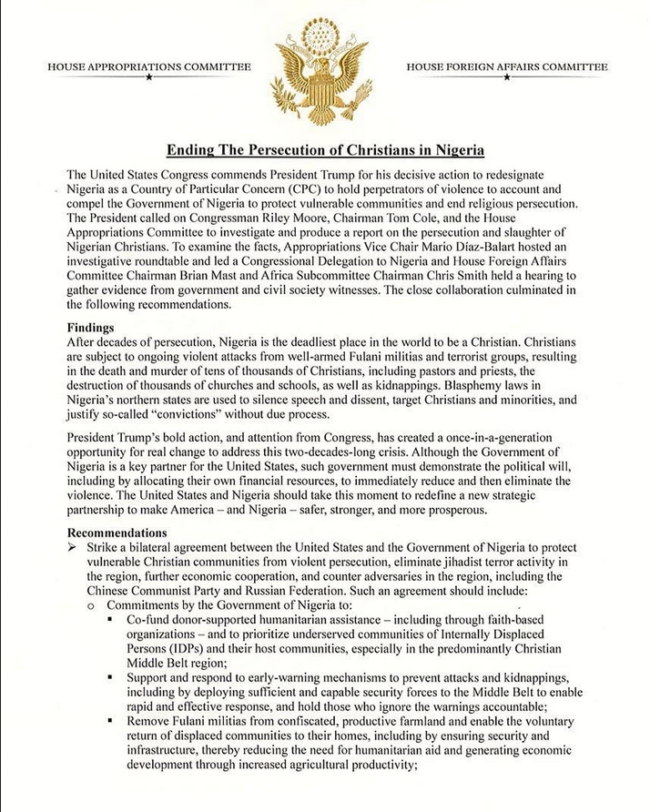
• Continue and expand security cooperation with the United States, including by divestment of Russian military equipment for American military equipment through sales and financing.
• Technical support to the Government of Nigeria to reduce and then eliminate violence from armed Fulani militias, including by:
• Developing a demobilization, disarmament, and reintegration program to address illicit weapons and support safer communities while allowing farmers to engage in legitimate self-defense;
• Supporting the new Ministry of Livestock, ranching plans, and meaningful land reform efforts; and
• Enhancing the recruitment, technical capabilities, and willingness of the security forces and military to prevent and respond to violent attacks.
• Comprehensive counter-terrorism cooperation to rid the region of Foreign Terrorist Organizations that pose a direct threat to the American homeland, including through the provision of excess defense equipment and use of relevant drawdown authorities.
• Counteract the hostile foreign exploitation of Chinese illegal mining operations and their destabilizing practice of paying protection money to Fulani militias.
Implement the National Security, Department of State, and Related Programs Appropriations Act, 2026, to support the preceding recommendations and the following priorities:
• Increased accountability by requiring proof of progress before obligating additional funds.
• Programs to address religious freedom, atrocity response, legal reforms, expand and improve policing, strengthen the criminal justice sector, improve anti-money laundering methods, and enhance capabilities to disrupt terrorist financing networks as well as capture illicit monies from Fulani militia members.
• Treasury Department programs and activities to strengthen the integrity of Nigeria’s financial system which will safeguard U.S. national security and enhance the favorable balance of trade for the United States.
U.S. Development Finance Corporation investments in Nigeria, especially in the Middle Belt.
• GAO audit report on the effectiveness of aid to Nigeria and recommendations for strengthened oversight.
• Invoke and publicly announce the CPC Presidential Directives to name and shame perpetrators of violence.
• Implement sanctions on groups and individuals who participate in, or tolerate violence against, Christians.
> Continue visa restrictions for perpetrators involved in Christian violence and violations of religious freedom.
> Demand the repeal of sharia codes and criminal anti-blasphemy laws.
> Review and use points of leverage to compel Fulani herdsmen to disarm, including by blocking export of beef and other cattle-related products to countries like Ivory Coast, Ghana, South Africa, and Senegal.
Ensure adequate staffing of diplomatic posts in Nigeria.
> Improve the Foreign Military Sales process to expedite the procurement and delivery of defense articles and services necessary to support shared security priorities.
> Require a National Intelligence Estimate (NIE) on Nigeria’s sectarian and communal violence, and review classifying Fulani militia groups with links to terror groups, as well as other groups conducting organized campaigns of violence that threaten the United States, as a Foreign Terrorist Organization.
> Enlist the support of international partners, including France, Hungary, and the United Kingdom.
Abuja has previously rejected claims of systematic religious persecution, claiming its commitment to protecting all citizens despite outcry from Nigerians of the complicity of the Nigerian government such as the continuous release of Fulani terrorists and reintegration into the army.
How the government responds to these proposals will shape future Nigeria-U.S. relations across security, economic and human rights dimensions.
By melding security realignment with economic and diplomatic strategy, the U.S. Congress’ recommendations mark a potential turning point in bilateral relations, one that blends hard and soft power to confront complex challenges in Nigeria and beyond.
Related Articles:
Congressman Riley Moore Delivers Congressional Report on Nigeria to White House
Israeli Parliament Debates Biafra, Signals Possible Further Engagement
