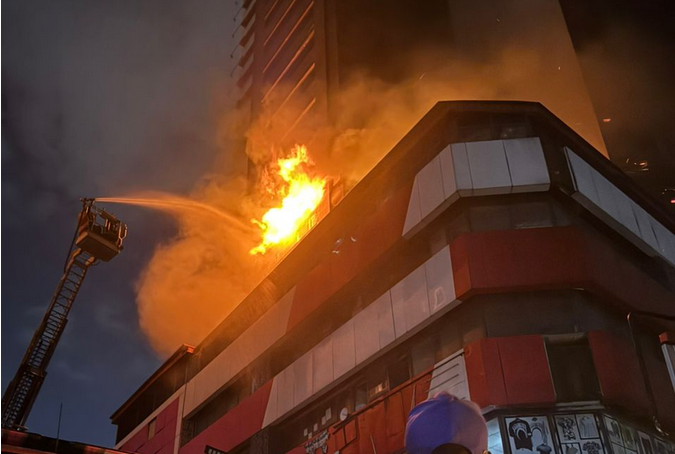
Fresh Fire Guts Igbo-Dominated Business Complex on Lagos Island, Raises Alarms Over Repeated Targeting
Lagos, Nigeria – December 24, 2025
Another Igbo-dominated commercial complex has been engulfed by fire on Lagos Island, intensifying fears among traders over what many describe as a troubling and recurring pattern of destruction of Igbo-owned business hubs in the area.
The inferno, which broke out on Christmas Eve, consumed a 25-storey business plaza identified as the Great Nigeria Insurance House, located on Martins Street, Lagos Island. The building is a major commercial hub housing shops, warehouses, and offices, with a significant number of businesses owned by Igbo traders.
Eyewitnesses at the scene described moments of panic and desperation as shop owners struggled to salvage their livelihoods amid the raging fire.
“The victims are throwing down their goods from their shops in an effort to save something,” an eyewitness lamented.
“But when they do so, the locals steal the goods. So the person not only risks his life, he still loses everything. One man said it is better not to risk his life throwing goods down only for criminals to steal them. These are Igbo people’s goods that are burning, and I suspect this is deliberate.”
Another witness said some traders initially refused to evacuate the building despite repeated warnings, driven by fear of total loss.
“They don’t want to come down. The fire is intensifying, and the people who own shops are trying to secure their goods. They are afraid to leave everything behind,” the eyewitness said.
Emergency responders eventually arrived at the scene, though traders complained of delayed intervention, a grievance that has accompanied previous fire incidents involving Igbo-dominated commercial complexes across Lagos state.
Reacting to the incident, the Permanent Secretary of the Lagos State Emergency Management Agency (LASEMA), Olufemi Oke-Osanyintolu, stated that preliminary assessments suggested the fire began from one of the offices on the fourth floor of the building.
“The fire, whose cause could not yet be ascertained, emanated from the fourth floor of the plaza before escalating to other floors,” he said, adding that the number of casualties could not be confirmed as rescue operations were still ongoing.
However, this account was publicly contradicted by the Controller-General of the Lagos State Fire and Rescue Service, Margaret Adeseye, who offered a different origin of the blaze.
In her statement, Adeseye said “The fire is currently affecting up to the fifth floor of a 25-storey building. It originated on the fifth floor and has spread downwards from that level.”
She confirmed that no casualties had been recorded as of the time of her briefing and described the building as “a business hub primarily used for shops selling clothing materials, warehouse storage and corporate offices.”
The conflicting official accounts have further fueled suspicion and distrust among affected traders, many of whom argue that fires have become a recurring threat to Igbo-owned commercial clusters in Lagos, often resulting in total losses without clear accountability or conclusive investigations.
While authorities insist the cause of the fire remains under investigation, affected traders and community members are calling for an independent and transparent probe, citing the frequency with which similar incidents have occurred in Igbo-dominated markets and business complexes across the state.
As smoke continues to rise from the ruins on Martins Street, many traders say the incident goes beyond an isolated fire outbreak, describing it instead as part of a broader pattern that leaves Igbo business owners repeatedly vulnerable, economically exposed, and without meaningful protection.
For now, Christmas has arrived on Lagos Island with celebration except for many Igbo traders, whose Christmas present arrived with ashes, unanswered questions, and renewed fears over safety, justice, and equal protection in one of Nigeria’s most important commercial districts.
For many Biafrans, this pattern of economic strangulation and targeted destruction of their livelihoods has become the final proof that their continued existence within Nigeria is untenable.
They argue that what is unfolding is nothing short of economic genocide, deliberately eroding their means of survival while offering no protection or justice.
In the face of these attacks and the state’s persistent failure or refusal to safeguard Biafran lives and property, the Nigerian government has instead positioned itself firmly against their right to self-determination, deploying force to suppress dissent.
This posture became unmistakable in 2021, when the Nigerian state abducted Mazi Nnamdi Kanu, leader of the Indigenous People of Biafra (IPOB), in clear violation of international norms.
Since then, scores of Biafrans, particularly IPOB members, have been killed, thousands unlawfully detained, and many others forcibly disappeared.
Despite multiple court rulings ordering Kanu’s release, including from the United Nations, the government has openly defied the judiciary.
To Biafrans, these actions confirm that justice, safety, and dignity are not attainable within Nigeria, and there is no attempt by the government to lie about it, reinforcing their resolve that the actualisation of Biafra is not only legitimate, but inevitable.
