
El-Rufai vs Ribadu: Poison Allegation Sparks Firestorm
Former Kaduna governor demands transparency over alleged importation of deadly toxin, calls for urgent probe
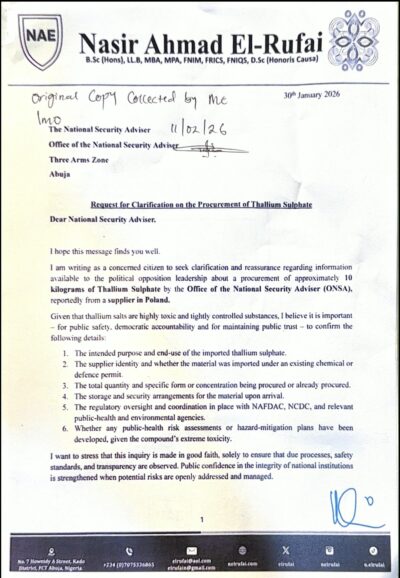
Nigeria’s political space has been jolted by a grave allegation from former Kaduna State Governor, Nasir El-Rufai, who has accused the National Security Adviser, Nuhu Ribadu, of importing a highly toxic chemical compound, Thallium Sulfate (Tl₂SO₄), into the country.
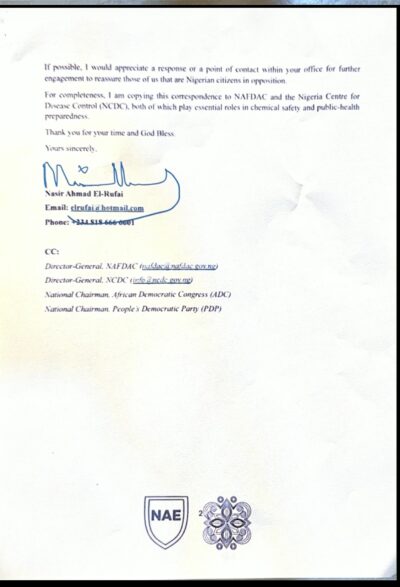
El-Rufai, in a strongly worded statement that has since sparked nationwide debate, demanded urgent clarification from security authorities, warning that the alleged importation of such a lethal substance raises serious national security concerns.
The accusation, if substantiated, could have far-reaching implications for Nigeria’s security architecture and public safety.
According to El-Rufai, Thallium Sulfate, described as a colorless, tasteless, and odourless toxic compound, was allegedly brought into Nigeria by the National Security Adviser under circumstances he believes require immediate public explanation.
He called on the Federal Government to disclose the purpose of the alleged importation, the quantity involved, the intended end users, and the safety protocols surrounding its handling.
El-Rufai did not present documentary evidence publicly at the time of filing this report but insisted that the gravity of the matter demands transparency.
Efforts to obtain an official response from the Office of the National Security Adviser were ongoing as of press time.
Thallium Sulfate (Tl₂SO₄) is a highly toxic chemical compound historically used as a rodenticide and insecticide before being banned or strictly regulated in many countries due to its extreme toxicity.
Toxicology experts describe it as particularly dangerous because it is colorless and odorless, it can be lethal in very small quantities, and symptoms of poisoning can be delayed, complicating diagnosis.
Scientific literature notes that acute exposure to thallium compounds can lead to severe organ damage, neurological failure, and death. Extremely small quantities can be fatal, although toxicity levels depend on dosage, route of exposure, and individual physiological factors.
During the Cold War era, various toxic substances were weaponized or allegedly deployed in covert operations by intelligence agencies globally.
The allegation emerges amid shifting alliances and rising tensions within Nigeria’s political elite. Observers say the timing of El-Rufai’s allegations adds another layer of complexity to an already volatile political atmosphere.
Security analysts caution that accusations involving chemical toxins must be handled with utmost care.
“This is not the kind of allegation that can float in the air unanswered,” said a Lagos-based security consultant who requested anonymity. “If false, it must be clearly debunked. If true, Nigerians deserve immediate reassurance about their safety.”
At the heart of the controversy lies a broader issue: public confidence in Nigeria’s security institutions.
The allegation comes barely 48 hours after a dramatic episode involving Nasir El-Rufai and staff of Department of State Security (DSS).
The former governor had earlier claimed on a social media post there was a failed attempt to abduct him, following the circulation of a viral video purportedly showing operatives of the State Security Service confronting him, an incident his supporters allegedly resisted.
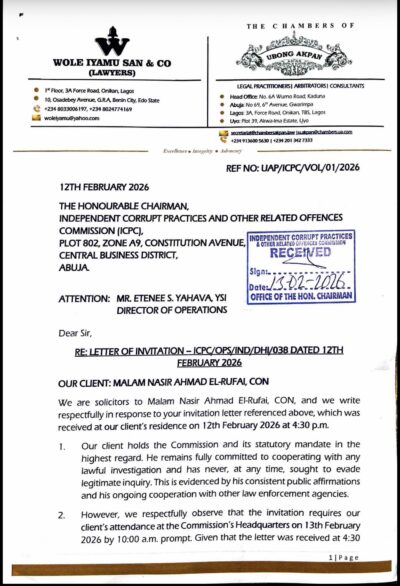
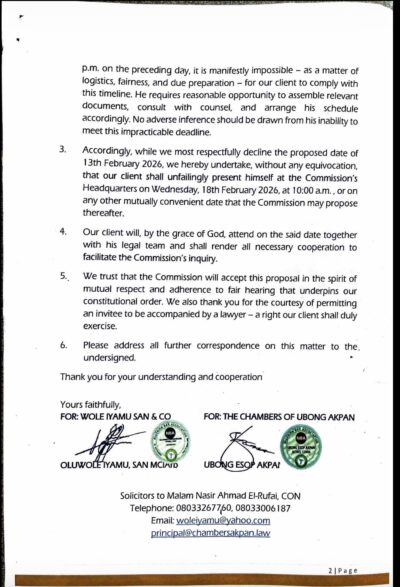
He described the attempt as “futile.” El-Rufai further disclosed that shortly after the incident, officials of the Independent Corrupt Practices Commission delivered a formal invitation letter requesting his appearance.
According to him, his legal counsel has responded in writing, confirming that he will honour the invitation and appear before the commission on Wednesday, February 18, 2026.
The Office of the National Security Adviser plays a central role in coordinating intelligence, counterterrorism, and internal security operations. Any suggestion involving the importation of a hazardous chemical compound inevitably triggers public anxiety especially as the government has been accused of complicity in the ongoing killing of Christians in Nigeria by Fulani terrorists.
The coming days may determine whether this is a political storm that dissipates or a security issue that demands deeper scrutiny.
Related Article:
Court Orders UK to Pay £20m Each to Families of 1949 Coal Miners
