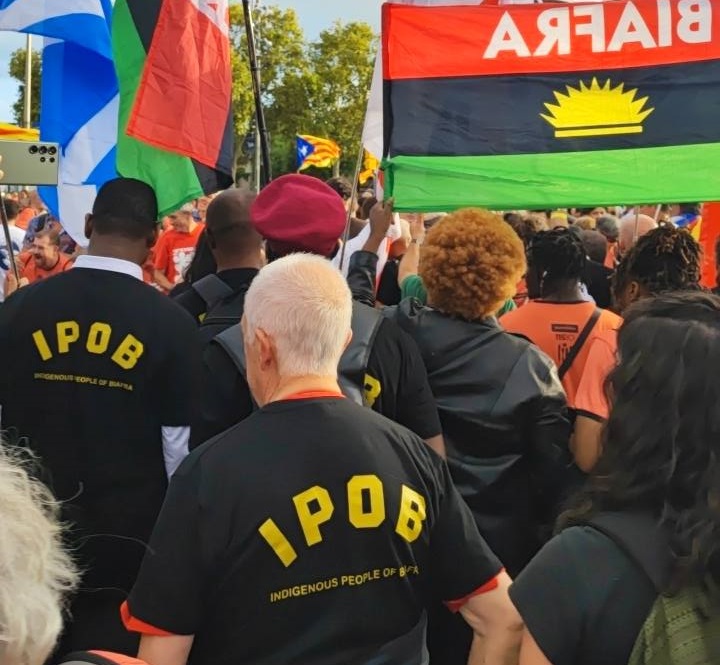
Chinasa Nworu Warns of ‘Bigger Battle’ for IPOB in 2026, Confirms Foreign Interests
The IPOB leader revisits October 2025 prediction, revealing geopolitical forces of Nigeria and France are aligning against the self-determination movement ahead of 2026.
A fresh social media post by a member of the Directorate of States (DOS) Mazi Chinasa Nworu has reignited debate over the future of the Indigenous People of Biafra (IPOB) and the security outlook in Nigeria’s South East ahead of 2026.
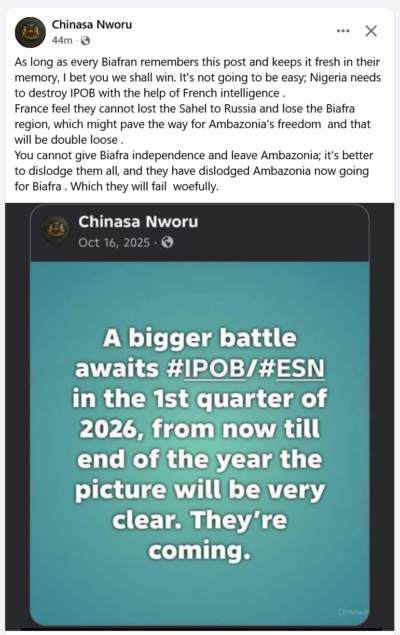
In his latest statement, Nworu urged supporters to revisit an earlier message he published on October 16, 2025, where he warned that “a bigger battle awaits IPOB/ESN in the 1st quarter of 2026,” adding at the time: “From now till end of the year the picture will be very clear. They’re coming.”
On Tuesday, he doubled down on that warning, highlighting that Nigeria would seek to “destroy IPOB with the help of French intelligence,” and linking the unfolding situation to broader geopolitical tensions in West and Central Africa.
“As long as every Biafran remembers this post and keeps it fresh in their memory, I bet you we shall win. It’s not going to be easy; Nigeria needs to destroy IPOB with the help of French intelligence”
He argued that France, facing growing influence from Russia in the Sahel region, would be unwilling to lose the Biafra region, stating that the freedom of Biafra could embolden freedom movements such as those in Ambazonia in Cameroon.
“France feel they cannot lost the Sahel to Russia and lose the Biafra region, which might pave the way for Ambazonia’s freedom and that will be double loose.”
“You cannot give Biafra independence and leave Ambazonia; it’s better to dislodge them all,” Nworu wrote, asserting that similar strategies had already been deployed in Ambazonia and would ultimately fail against the Biafran cause.
Context and Background
The Indigenous People of Biafra (IPOB) is a peaceful movement seeking the restoration of Biafra, a nation that existed before it’s fall in 1904 to the British empire and its forceful amalgamation into Nigeria in 1914.
Critics argue that the forced union of diverse regions under colonial administration laid the structural foundation for decades of political imbalance and unresolved national tensions.
Following Nigeria’s independence in 1960, the Nigerian government allegedly sponsored the massacre of over 100,000 of Biafrans in the Northern region of the country, causing a rapid deteriorating of relationship.
This massacre triggered their mass return to their region (Biafra), and was followed by negotiations between the regional government and the federal government for reparations and justice for the victims, both of which never materialized.
What followed was the invasion of the Biafran region in 1967 by federal troops leading to a massacre of over 7 million Biafrans between 1967 to 1970, according to reports.
As a result of the superior weapons on the side of the Nigerian government, they were able to blockade Biafrans on air, land, and sea, resulting in a catastrophic humanitarian consequences with millions of Biafran children starved to death.
Images of malnourished children from that war became some of the most haunting symbols of post-colonial Africa.
The Biafran side surrendered in 1970 and the Federal Government announced a policy of “Reconciliation, Reconstruction and Rehabilitation,” pledging to reintegrate the region.
Critics argue that these promises were not implemented and that the region has since experienced structural marginalization, an allegation the Nigerian government disputed.
The marginalization of the region has once again sparked uproar when a new government approved history text for Secondary school students is shown not to include the history of the region.
Meanwhile, France has historically maintained strategic military and political interests across the Sahel, particularly in former colonies where it was forced out and accused of sponsoring terrorism operations which these countries continue to battle.
While tensions in the Sahel have intensified following shifts in alliances and the growing presence of Russian-linked actors, direct evidence linking those dynamics to Nigeria’s internal self-determination issues remains a matter of regional politics.
Rising Rhetoric Ahead of 2026
Nworu’s renewed message comes at a time where the government has been fingered in the insecurity in the region.
Security forces and criminal groups allegedly sponsored by the government have led to deaths, organ harvesting, and disappearances, creating widespread fear among civilians.
Observers note that exposing such major confrontations is necessary to heighten expectation on the ground to avoid confusion amongst supporters when the attack begins.
Civil society groups have repeatedly called for de-escalation, dialogue, and transparent communication from the federal government of Nigeria to prevent further instability.
Amnesty International have accused the Nigerian security forces of carrying out a brutal campaign of extrajudicial killings against peaceful pro-Biafra supporters in the region.
As 2026 continues, the region’s political temperature appears to be rising. What is clear, however, is that narratives of foreign interference and strategic rivalry are increasingly shaping conversations around Nigeria’s long-running self-determination movement.
Related Articles:
IPOB Marks ‘Trump Solidarity’ Rallies, Renews Outcry Over 2017 Killings and Kanu’s Detention
Police Shot 15-Year-Old Playing Outside, Called Him ‘Armed Robber’ — Amnesty International
