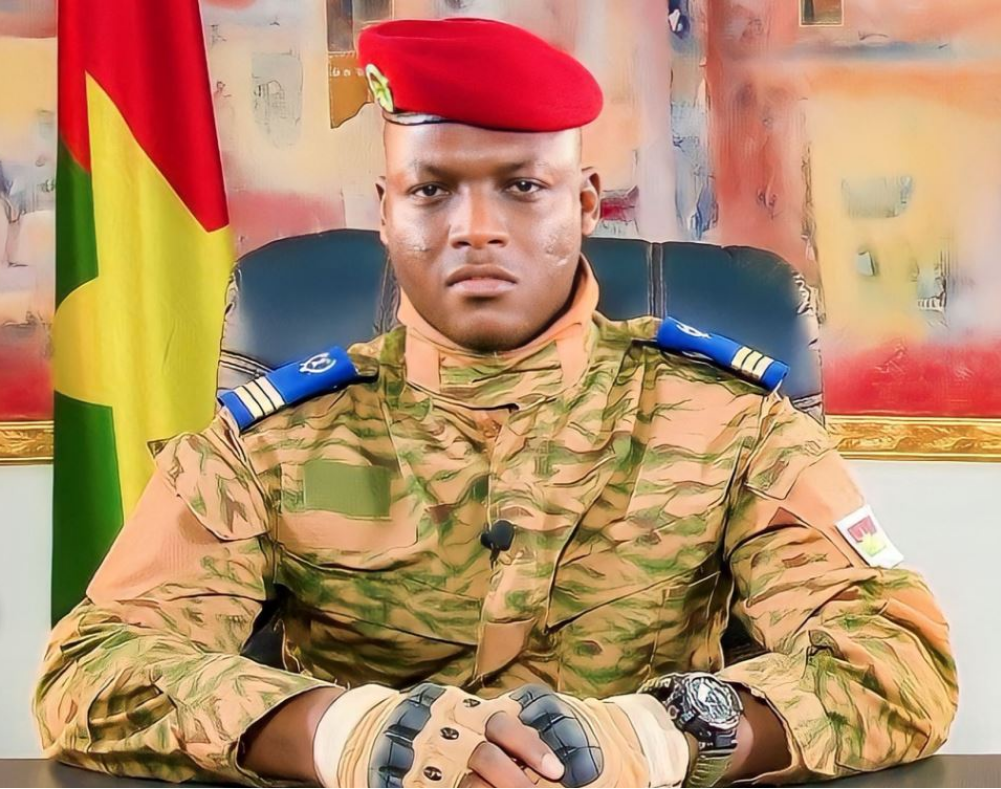
Burkina Faso Foils Alleged Fresh Assassination Plot Against President Traoré
Ouagadougou, Burkina Faso – January 8, 2026
The government of Burkina Faso has announced that it has successfully thwarted an alleged plot to assassinate President Captain Ibrahim Traoré and plunge the country into fresh instability, in what authorities describe as yet another attempt to derail the nation’s fragile transition.
Addressing the nation on state television RTB, Burkina Faso’s Minister of Security, Mahamadou Sana, disclosed that the plot was allegedly orchestrated by former transitional president, Lieutenant-Colonel Paul-Henri Sandaogo Damiba, whom Captain Traoré ousted in a September 2022 coup.
Sana further alleged that the plan was financed from neighbouring Ivory Coast, an allegation that has already stirred diplomatic tension in the sub-region.
According to the security minister, the foiled operation was not a single-day scheme but a coordinated plan involving targeted assassinations of key military and civilian figures, with the ultimate objective of eliminating President Traoré himself.
“The first phase was to neutralise the Head of State,” Sana said, adding that the conspirators intended to sow chaos within the armed forces and the civil administration, creating room for a forceful return to power.
He accused Damiba of planning, funding and recruiting participants, while reassuring Burkinabè citizens that security forces remain in full control of the situation.
As of the time of reporting, neither Ivory Coast nor Lieutenant-Colonel Damiba has responded to the allegations.
However, the accusation has reignited longstanding suspicions between Ouagadougou and Abidjan, following previous claims by Burkina Faso’s military rulers that coup plotters often find refuge or support across the border.
Ivory Coast has consistently denied such accusations in the past, but the repeated claims underscore a growing trust deficit within the West African sub-region, already strained by political instability and military takeovers.
Captain Traoré came to power in September 2022, removing Damiba, who himself had overthrown President Roch Marc Christian Kaboré just eight months earlier in January 2022.
Since Traoré’s takeover, authorities say they have foiled multiple coup attempts, blaming aggrieved persons within the military who feel they are no more benefiting from corruption, and alleged external interference.
The government argues that these plots undermine its stated mission of reclaiming territory from terrorists and restoring national sovereignty.
The latest allegations add to the growing unease in West Africa, where military governments in Burkina Faso, Mali and Niger have accused foreign powers and neighbouring states of meddling in their internal affairs.
Mali, Burkina Faso and Niger have formally exited the Economic Community of West African States (ECOWAS), marking a historic rupture in regional integration and giving birth to a new bloc known as the Alliance of Sahel States (AES).
Defined as an act of sovereignty and self-preservation, the move reflects deep resentment over ECOWAS perceived as a tool of foreign influence, and what they describe as selective morality in regional politics.
The formation of AES signals a reordering of power in West Africa, with the Sahel states choosing collective security and political alignment outside the traditional ECOWAS framework.
Tensions in the region have been further inflamed by Nigeria’s military incursion into Republic of Benin, an action that sent shockwaves across West Africa and deepened mistrust among neighbouring states.
Coming at a time of already strained relations, the development has reinforced fears of unilateralism and coercion by dominant regional powers, accelerating the breakdown of confidence in collective security arrangements.
For many in the Sahel, this moment confirms long-held suspicions that regional institutions are no longer neutral arbiters, but instruments of power politics, pushing West Africa into an era of uncertainty and hardened blocs.
Analysts warn that the recent accusation of Coup, if not carefully managed, could deepen regional fractures at a time when cooperation is critical to tackling terrorism and economic hardship.
Despite the gravity of the claims, the Burkinabè authorities have struck a tone of confidence. Minister Sana insisted that the plot had been neutralised before it could cause harm and urged citizens to remain calm.
“Our forces are vigilant,” he said, projecting an image of a government determined to hold the line against both internal betrayal and external pressure.
As investigations continue, the episode once again highlights a central reality of Burkina Faso’s politics: power remains contested, fragile, and fiercely guarded, with the shadows of past leaders and regional rivalries never far from the seat of authority.
Related New
France, Nigeria Deploy Air Power Over Cotonou as Benin Government Claims It Foiled Coup Attempt
The Nigerian Senate Approves Troops Deployment to Benin Republic Following Coup Attempt
Burkina Faso Rejects U.S. Proposal to Accept Deported Migrants, Asserts National Dignity
AES Intercepts Nigerian Warplane – Forces It Down and Detains Entire Crew!
