
Nigeria Is More Equipped With Corruption Than Technology – Ifeanyi Ejiofor
In an Era of Ballistic Power, Can Nigeria Defend Its Tomorrow?
As ballistic missiles redraw skylines in distant regions and advanced defense systems light up foreign night skies like coded constellations, a sobering question drifts toward Nigeria’s horizon: if such firepower were aimed anywhere near our borders, would we even see it coming?
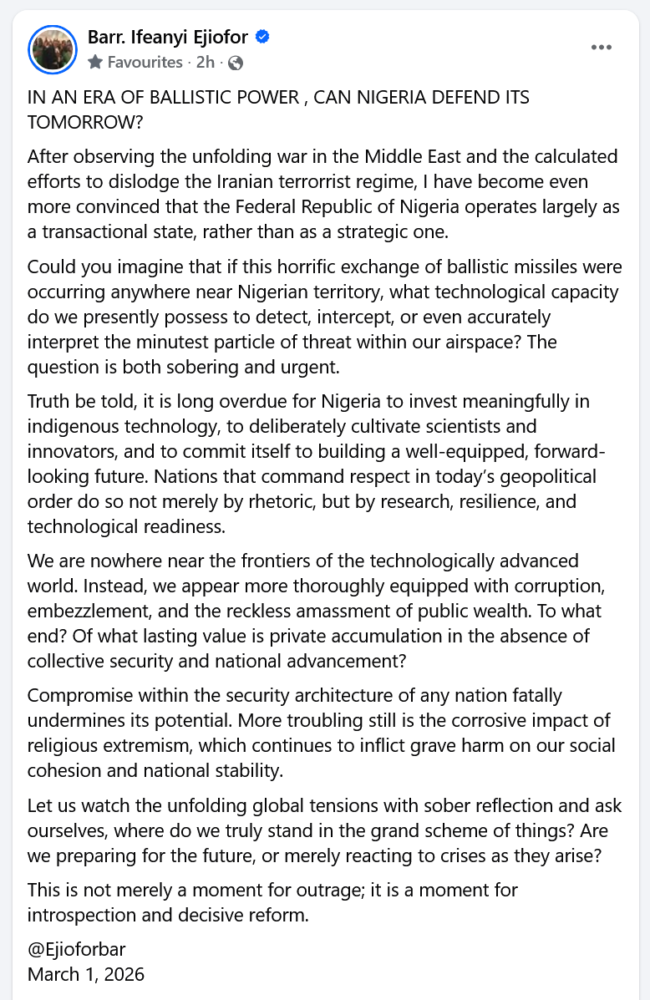
That is the troubling reflection posed by Barrister Ifeanyi Ejiofor, lawyer to the Indigenous People of Biafra and a prominent human rights advocate, in a statement issued on March 1, 2026.
Observing the escalating conflict in the Middle East and the calculated military maneuvers reshaping regional power structures, Ejiofor argues that Nigeria operates less as a strategic state and more as a transactional one. In his assessment, governance in the country is driven more by short term political and economic exchanges than by long term national planning.
Ejiofor raises an urgent and uncomfortable reality. If a barrage of ballistic missiles were to approach Nigerian territory, does the country possess the technological capability to detect, intercept, or even accurately interpret the smallest threat within its airspace?
He questioned Nigeria’s air defense systems, satellite intelligence, radar infrastructure, cybersecurity, research investment, and scientific manpower. In an age where nations invest heavily in indigenous innovation and homegrown technological ecosystems, Nigeria, he suggests, lags dangerously behind.
Countries that command respect in today’s geopolitical order do so not by rhetoric alone, but by research, resilience, and readiness. Advanced nations cultivate scientists with the same seriousness that they recruit soldiers. They treat laboratories as strategic assets and innovation as a matter of national security.
Ejiofor’s most pointed criticism is not directed outward but inward. Nigeria, he argues, appears “more thoroughly equipped with corruption, embezzlement, and the reckless amassment of public wealth” than with cutting edge technology.
He questions the logic of private accumulation in the absence of collective security. Of what enduring value is wealth hoarded in isolation, he asks, if the broader society remains technologically fragile and strategically exposed?
In his view, compromise within a nation’s security architecture weakens not only its defenses but its future. When corruption penetrates procurement systems, research funding, and defense planning, the consequences are structural rather than cosmetic. The result is a nation reacting to crises rather than anticipating them.
Beyond technological gaps, Ejiofor also warns of the corrosive impact of religious extremism on Nigeria’s social cohesion. He argues that ideological radicalization compounds structural weakness, eroding trust, stability, and national unity at a time when internal strength is essential.
As global tensions intensify and military technologies evolve at dizzying speed, Ejiofor calls for sober introspection. Where does Nigeria truly stand in the grand scheme of things? Is the country preparing deliberately for the future, or merely improvising in the face of recurring emergencies?
He sees the current moment not as one for outrage alone, but for decisive reform. Meaningful investment in indigenous technology, deliberate cultivation of scientists and innovators, and a forward looking national strategy, he suggests, are no longer optional. They are existential necessities.
In an era defined by ballistic power and digital warfare, tomorrow will belong to nations that build with intention. The pressing question is whether Nigeria will choose to become one of them.
Related Articles:
IPOB Lawyer, Ejiofor Exposes Fake IPOB Sit-at-Home Order, Warns Ndi-Igbo
