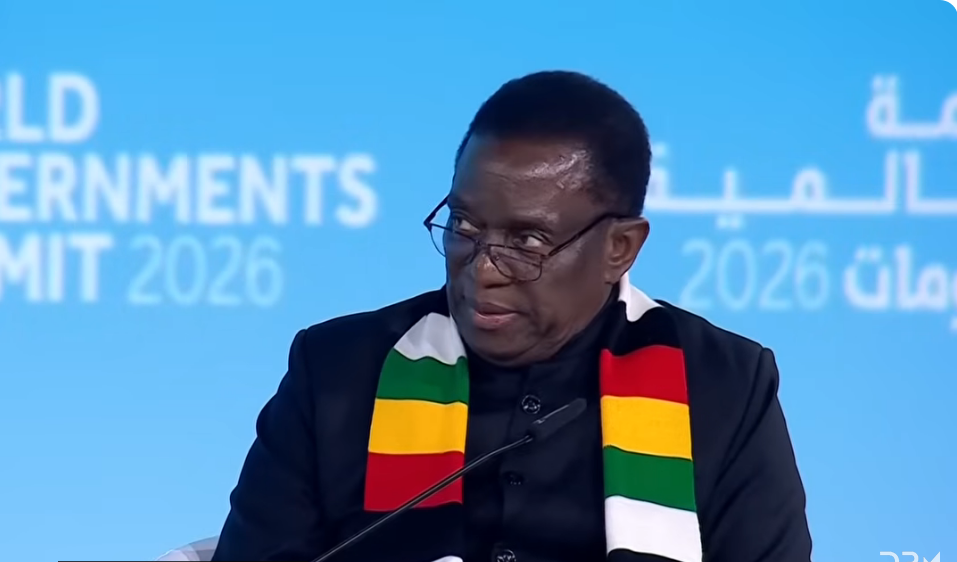
Zimbabwe President Defends Seizure of Lands From Colonialists, Says Land Belongs to Zimbabweans
Mnangagwa tells Tucker Carlson Zimbabwe answers to its people, not East or West, as he defends land reform, sanctions resistance, and Africa’s right to choose its partners.
In a wide-ranging interview that cut through decades of Western narratives, Zimbabwean President Emmerson Dambudzo Mnangagwa at the World Government Summit in Dubai, firmly defended his country’s land reform policy, and described it it as a matter of national sovereignty and historical justice rather than racial targeting.
Speaking with American broadcaster Tucker Carlson, President Mnangagwa positioned Zimbabwe not as a subject of foreign approval, but as a self-determining state that has paid a heavy price for reclaiming its land and independence.
Looking Beyond Western Narratives
At the heart of his message was a simple and stern statement: Zimbabwe does not exist to please the West or the East. It exists to satisfy the aspirations of Zimbabweans.
On the question of China versus Western powers, Mnangagwa rejected the binary often imposed on African states.
He acknowledged that in the early years after independence, Zimbabwe relied heavily on Western development support, but noted that the country has since diversified its partnerships making investment and cooperation from countries like China also pivotal.
“As we have evolved, we have also benefited from investment and cooperation from countries like China,” he said, framing the shift not as ideological alignment, but as pragmatic statecraft.
When pressed on whether China offers Africa a better deal than the West, Mnangagwa challenged the premise of the question itself. Zimbabwe, he stressed, negotiates from the position of sovereignty, not dependency.
“Zimbabwe is a sovereign state, and we move on the basis that gives us the best results from our resources,” he said. “Whether it is relations with the West or the East, what is primarily important is what we ourselves are satisfied with. We don’t need to please the West or please the East. We please ourselves.”
That assertion struck at the core of Africa’s long struggle against Western control, echoing sentiments widely shared across the continent, including in Nigeria, where debates around sovereignty, resource control, and foreign influence remain unresolved.
Mnangagwa also dismissed attempts to generalise how “the East” or “the West” does business in Africa, arguing that international relations are shaped by history, context, and mutual interest, not sweeping stereotypes.
“Relationships depend on the historical background of countries, between one country and another,” he explained. “That’s the base on which relations grow and are nurtured.”
As a former British colony, Zimbabwe’s relationship with the West remains deeply scarred by history. Yet Mnangagwa made it clear that the country has chosen to move forward without bitterness, forging new alliances while standing firm on its past decisions.
Defending Land Reform and Sanctions
The most pointed exchange came when Carlson raised Zimbabwe’s controversial land reforms that intensified in the early 2000’s, often described in Western media as the expulsion of white farmers and blamed for the country’s economic collapse.
Mnangagwa rejected that framing outright, acknowledged that Zimbabwe’s economy has faced “challenges” but linked much of Zimbabwe’s economic hardships to decades of Western sanctions imposed after the country reclaimed land from British colonial control.
“Zimbabwe has been under sanctions for decades as a result of us claiming our land from the British and making ourselves independent,” he said. “We seized the land and gave it to our people, so sanctions were imposed on us.”
Despite these constraints, the president insisted Zimbabwe has endured and grown on its own terms, describing the struggle as the price of genuine independence.
“We are happy that we have developed on our own, and we feel very independent,” he added.
When confronted with claims that the land policy targeted individuals based on skin colour, Mnangagwa drew a sharp historical line. The issue, he said, was never race, but ownership and justice.
“Land did not belong to a race. It belonged to Zimbabweans,” he said, describing it as a restorative act after colonial dispossession, not racial exclusion, and noted that those who chose to stay under equal terms did so, while others left.
“When colonialists took land from us, time came when we asserted ourselves and took back our land.”
Those who chose to remain under the same conditions as indigenous Zimbabweans were free to do so, he explained. Those who viewed themselves as superior opted to leave.
On Global Affairs Beyond Zimbabwe
In closing, Mnangagwa briefly addressed global affairs beyond Africa, including Venezuela, he admitted that he did not have enough verified information to speak definitively about developments in distant Venezuela, saying: “Venezuela is far from Zimbabwe… but from what we read, we are interested to know why it is happening.”
African Sovereignty in Focus
The interview highlighted a broader theme in Mnangagwa’s leadership: a firm assertion of Zimbabwe’s sovereignty and a rejection of narratives that frame African agency as secondary to Western or other external influences.
For the president, relationships with global powers are not zero-sum competitions but decisions to be made on Zimbabwe’s own terms.
Observers say this posture reflects a growing sentiment among some African leaders who believe the continent must chart independent courses in international relations, economic cooperation, and the stewardship of natural resources, a stance that resonates deeply with citizens who remember colonial injustices and continue to seek genuine self-determination in the 21st century.
Related Articles:
DNA Test Uncovers 18-Year Baby Swap Nightmare at Mpilo Hospital
Court Orders UK to Pay £20m Each to Families of 1949 Coal Miners
