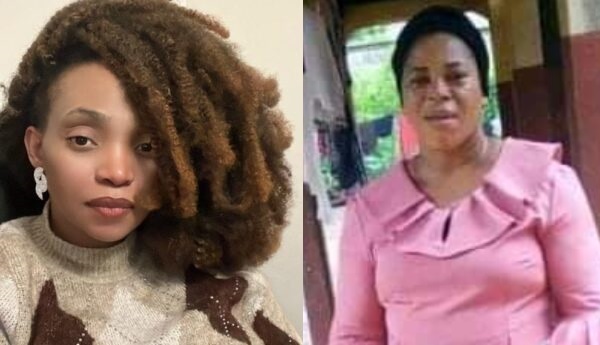
DSS Custody Death of Calista Ifedi, “A War Against Human Dignity”
Enugu, Nigeria – January 23, 2026
Lolo Uchechi Okwu-Kanu has expressed outrage regarding the death of Mrs. Calista Ifedi, a food vendor and mother who reportedly died while in the custody of Nigerian security forces at the DSS-run Wawa Barracks in Niger State, years after she was kidnapped from her home by Nigeria’s secret police, DSS.
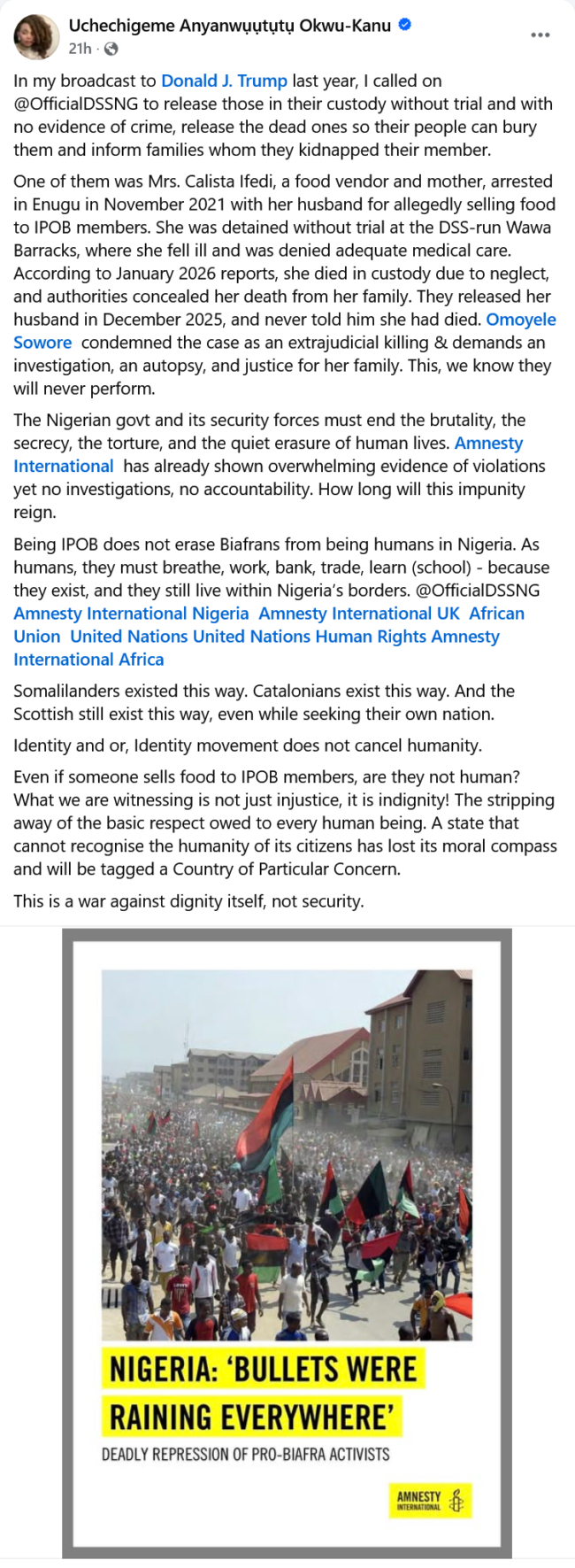
In a detailed public statement, Okwu-Kanu lamented that “Mrs. Calista Ifedi, a food vendor and mother, arrested in Enugu in November 2021 with her husband for allegedly selling food to IPOB members was detained without trial at the DSS‑run Wawa Barracks, where she fell ill and was denied adequate medical care.”
Her statement reignited concerns about prolonged detention without trial, custodial neglect, and the concealment of deaths by Nigeria security agencies.
Citing reports that emerged in January 2026, Okwu-Kanu states that Mrs. Ifedi died in custody due to medical neglect, and that authorities failed to inform her family of her death, and continued to hold her husband in custody until December 2025, when he was released without being told that his wife had already died.
“These are not security operations,” Okwu-Kanu wrote. “This is quiet erasure.”
Calls for Investigation and Accountability
The allegations have drawn condemnation from activist and former presidential candidate Omoyele Sowore, who described the case as an extrajudicial killing and publicly called for an independent investigation, including an autopsy and full accountability for those responsible.
However, Okwu-Kanu expressed deep skepticism that such steps would be taken, arguing that past cases involving alleged abuses by security agencies have followed a familiar pattern: public outrage, official silence, and no consequences.
She referenced longstanding documentation by Amnesty International, which has repeatedly accused Nigerian security forces of arbitrary detention, torture, and custodial deaths, particularly in cases linked to separatist movements in the South East.
Despite what she described as “overwhelming evidence,” she noted that prosecutions and transparent inquiries remain rare.
“Amnesty International has already shown overwhelming evidence of violations yet no investigations, no accountability. How long will this impunity reign.”
“The Nigerian govt and its security forces must end the brutality, the secrecy, the torture, and the quiet erasure of human lives.”
Humanity Beyond Politics
At the heart of Okwu-Kanu’s intervention is a broader argument about citizenship, identity, and state power. She presented the incident as part of a broader pattern of dehumanisation, and rejected the notion that association, real or alleged, with IPOB strips individuals of their basic rights.
“Being IPOB does not erase Biafrans from being human in Nigeria,” she stated, insisting that all citizens retain the right to “breathe, work, bank, trade, learn (school) – because they exist, and they still live within Nigeria’s borders,” regardless of political beliefs or identity movements.
She drew international comparisons, pointing to Somalilanders, Catalonians, and Scots, noting that identity movements elsewhere have not resulted in the systematic dehumanisation of ordinary civilians.
“Somalilanders existed this way. Catalonians exist this way. And the Scottish still exist this way, even while seeking their own nation. Identity and or, Identity movement does not cancel humanity.”
According to her, Nigeria’s response goes beyond law enforcement into something more corrosive.
“Even if someone sells food to IPOB members, are they not human?” she asked.
A Crisis of Moral Authority
Okwu-Kanu warned that the continued pattern of secrecy, torture, and custodial deaths justifies branding Nigeria as a Country of Particular Concern in international human rights assessments. In her words, the issue is no longer just about security or separatism, but about the state’s moral standing.
“What we are witnessing is not just injustice,” she wrote. “It is indignity. The stripping away of the basic respect owed to every human being.”
She further cautioned that “a state that cannot recognise the humanity of its citizens has lost its moral compass”
She tagged multiple international bodies and institutions, including the African Union, the United Nations, and various branches of Amnesty International, urging them to pay closer attention to the sustained campaign of repression against civilians in the South East.
Unanswered Questions
As of the time of publication, Nigeria’s Department of State Services (DSS) has not publicly responded to the specific allegations concerning Mrs. Calista Ifedi. No official statement has confirmed or denied her detention, illness, death, or the circumstances surrounding it.
For Mrs. Ifedi’s family, the questions are painfully basic: Where is her body? When did she die? Why were they not informed? Why would a country abduct an innocent citizen and kill her in their custody?
For the wider public, the case raises deeper concerns about due process, transparency, and the limits of state power.
Whether these allegations will prompt an independent inquiry remains uncertain. What is clear is that the story of Mrs. Calista Ifedi has become a symbol in a much larger debate about human dignity, accountability, and the cost of silence in Nigeria’s ongoing security crisis.
Related Articles:
Sowore Demands Accountability as DSS Admits Mrs. Ifedi Died in Illegal Detention
Amnesty: Nigeria Ignores Evidence, Refuses to Probe Killings of IPOB Members by Security Forces’
